
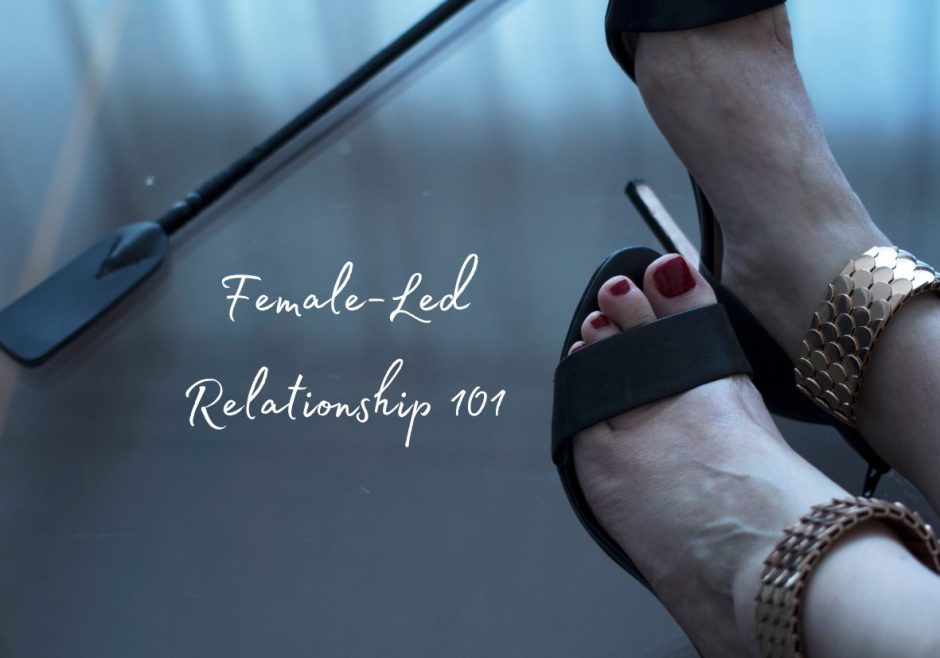
Inequality in heterosexual relationships, from the persistent gender pay gap and unequal division of household labour to the orgasm gap, is remarkably persistent under patriarchy. Most of us would agree that eliminating inequality and creating more equal and balanced relationships is a good thing. But for some people, a consensual and negotiated imbalance of power is actually what they want in their relationships. This type of dynamic is often called a Dominant/submissive, or D/s, relationship. Today we’re taking a close look at one such type of BDSM dynamic: female-led relationships, or FLR.
FLR 101: What is a Female-Led Relationship?
In general, the term female-lead relationship (FLR) is used to refer to a heterosexual (or hetero-read, because some people in FLRs may be bisexual, pansexual, or queer) BDSM relationship in which the woman is in charge.
The level of control in an FLR can vary significantly, depending on what the people involved want. It might be as simple as the woman taking charge of the majority of day-to-day decision-making within the relationship, or as complex as intricate systems of rules with consequences, rewards, and punishments built in. The term FLR is usually applied when the D/s aspect of the relationship extends beyond the bedroom, though this isn’t an absolute rule.
Some people view FLR as simply “role reversal,” but it’s not that simple. A female-led relationship isn’t about reversing gender inequality. It’s not about placing a man into the subservient, second class role that women have historically been forced to occupy. Instead, it is about consensual and negotiated inequality that exists for the enjoyment and fulfilment of both parties.
The cornerstone of FLR and any other form of D/s is consent. Either partner must be able to withdraw that consent at any time.
Gender inequality under patriarchy is rooted in misogyny and male supremacy. FLR is not rooted in hatred of men or female supremacy, but in mutually satisfying and negotiated relationships between people who care for one another.
Why Does FLR Strike a Chord with So Many?
“Everything in the world is about sex except sex. Sex is about power.” So goes the likely-apocryphal quote often attributed to Oscar Wilde.
D/s relationships of all kinds may strike a chord with people because power and sexuality are so inextricably linked. This can mean that playing with power and power imbalances in a consensual context can be incredibly sexy.
There are numerous other reasons why someone might enjoy an FLR BDSM dynamic, and the only way to know what is true for any individual is to ask them. For some men who submit to their female partners, it’s about having a break from the responsibilities they have in their day to day lives (many men who are submissive at home have high-flying, high-pressure jobs.)
Some men also find that taking on a submissive role frees them from the expectations and constraints of toxic masculinity. Submitting allows them to be vulnerable, to stop fearing appearing “weak,” and to be taken care of by a trusted partner.
For dominant women, some enjoy the feeling of power and strength that comes from taking on a dominant role. It can be highly erotically charged to have someone do exactly as you tell them, in or out of the bedroom.
Many dominant women also find that their submissive partners are more attentive to their needs, increasing their sexual and romantic satisfaction in the relationship. Being dominant can also involve taking care of your partner, and some women enjoy bringing a nurturing side to their BDSM through FLR.
The more interesting question is always “why does FLR strike a chord with you?” If you can answer this question, you’ll have the best chance of building the relationship that works for you and your partner.
Female-Led Relationships and Chastity: What’s the Connection?
Many, though not all, female-led relationships include an element of chastity play. Chastity refers to restricting someone’s ability to experience sexual pleasure or reach orgasm. It often involves the use of a chastity cage or chastity device, which physically prevents the wearer from masturbating, having sex, and sometimes even getting an erection. Chastity can also be practiced without a device, relying on psychological power and an “honour system.”
People in FLRs practice chastity in many different ways. Some do it occasionally as a form of foreplay, increasing desire and ramping up the tension before sex or a play session. Others lock their partners up long term, anything from days to weeks or months at a time. Chastity play may also include periods of tease and denial or edging—bringing someone close to orgasm without letting them go over the edge.
Chastity play can be hot for so many reasons. Most obviously, not allowing release for a period of time increases arousal. This allows desire to build and build with nowhere to go. It can also make the eventual orgasm so much more intense. Handing someone else control of your sexual pleasure is, for some people, the ultimate act of submission.
Don’t forget to play safe if you’re doing chastity, particularly long-term chastity. Dan Savage spoke to a certified urologist in this article, who offered some thoughts on the potential risks and some of the ways to mitigate them.
You must assess your own level of acceptable risk. Either way, it’s probably smart to take off your device and give your cock a break once in a while. You should also ensure that the wearer always has a spare key in case of emergencies. You can also read more about chastity safety and hygiene here.
What Makes a Successful FLR BDSM Dynamic?
Ultimately, FLR and other BDSM dynamics are still relationships. This means that all the ingredients that go into making any relationship work still apply here. Trust, communication, and compassion must be front and centre at all times.
Taking on a dominant role in a relationship is a position of great responsibility. This means that you need a lot of trust, and that this trust must go both ways. The submissive man needs to know that his partner will respect his limits, honour his vulnerabilities, and act in his best interests. And the dominant woman needs to trust that her partner will be honest about his needs and boundaries, speak up if something is wrong, and treat her as a full human being and not a fetish fulfillment machine.
Even if you are living in an FLR or any BDSM dynamic full-time, it is vital to be able to step out of role and communicate with one another as equals when required. I always recommend setting aside time for a regular check-in in any D/s relationship. This gives you time to address any issues and ensures that problems won’t be left to fester. You can also agree on a specific safeword which means “I need to talk to you as equals right now.”
Compassion means treating each other with kindness, consideration, and empathy. Even in a D/s relationship, life is still life and you will both have good days and bad days. While FLR can be a central component of your relationship, it should never override seeing one another as partners first and foremost.
How Can I Find a Partner for an FLR BDSM Dynamic?
Glance at any BDSM forum or discussion space, and you’ll find complaints that submissive men enormously outnumber dominant women. I don’t know whether this is actually true, as there aren’t any reliable statistics on this as far as I know.
What I do know is that there are likely far more kinky people out there than you think, and that there are things you can do to improve your chances of finding the Domme of your dreams as a single submissive man. All of these guidelines also apply if you’re a dominant woman seeking a submissive, too.
First, get involved in your local BDSM community. This is the best way to meet other people who might be interested in this kind of lifestyle. Complete your Fetlife profile, attend some munches and play events, and get to know people. The trick here is to treat everyone as a potential friend, not a potential partner. You’ll build a positive reputation, start getting invited to more events and parties, and the rest will follow.
Next, be yourself. There’s no point putting on an act that represents what you think a dominant or submissive is “supposed” to be. You want to end up in a relationship with someone who loves you for who you really are.
Remember: A Female-Led Relationship is Still a Relationship
Approach any potential FLR or other BDSM dynamic as a relationship first. Compatible kinks and desires are important, but they’re not enough to sustain a relationship by themselves. You’ll also need to enjoy each other’s company, respect each other, have fun together, and have compatible long-term goals.
Finally, be patient. It can take a while to find the right person, but when you do, the rewards can be tremendous.
I’d like to thank today’s sponsor, LockTheCock, for their kind support of this post. Check out their wide range of chastity cages and accessories on their website! All views and writing are, as always, my own.
Just read FLR 101, after reading a Masturbation Monday post.
Major WOWs across the board. Exceptional rhetoric is clear, concise, accurate, educational, &, arousing.
I’m so grateful I stumbled across Coffee & Kink. Many thanks.