Richard and Sutton: Fundamental Incompatibilities, and Happy Ever After

Like many fans of Freeform’s The Bold Type, I was rooting for a happy ending for Sutton Brady-Hunter and Richard Hunter (known collectively by the fandom as “Suttard”) as the show wrapped up its final season. From their attempt at a Bluetooth vibrator sex date to their adorable Paris reunion, Richard and Sutton (played by Sam Page and Megan Fahy, respectively) have been one of the show’s strongest couples from the beginning.

Fair warning: spoilers for all five seasons of The Bold Type and its ending incoming!

At the end of The Bold Type season 4, the newly married couple have a blow-out argument when Sutton realises she doesn’t want to have children while Richard longs to be a dad. At the beginning of season 5, he leaves her and begins divorce proceedings.

Over the course of the final season, Sutton destroys her wedding dress, throws a “divorce party,” starts therapy, and quits drinking in an attempt to get over Richard and get her life back together. Then they meet up to swap divorce papers, inevitably fall into bed with one another, and Richard realises how much he loves Sutton and that he doesn’t want a life without her. Even if it means giving up his dream of having children.

So far, so romantic, right? But…

Richard and Sutton Are Fundamentally Incompatible

No two people will ever be perfectly aligned on every issue or desire. That’s impossible because we’re all multifaceted, nuanced, and complex creatures. But there are, I believe, a few compatibility fundamentals. These are the things you need to agree on (or at least be genuinely, wholeheartedly happy to compromise on) in order to have a functional relationship.

Having children is one of those things. Others might include getting married or not, being monogamous or not, and possibly even political affiliation.

Some things are just deal breakers. Some things should be deal-breakers. Because in reality, much as we want to believe that love conquers all, it doesn’t. Love doesn’t conquer wanting different things in uncompromisable situations. You can’t have half a child. You can’t be half married. Love, however real and powerful, doesn’t make these incompatibilities go away or create the potential for a compromise where there is none. Sutton and Richard’s ending neatly sidesteps this reality.

Fairytale Endings: Fantasy vs. Reality

I’m glad the writers chose to end The Bold Type the way they did. Ultimately, this show is escapist fantasy, a Sex & the City for millennials with little grounding in the real world. Richard and Sutton fans were crushed when the couple split up and were rooting for them to get back together and somehow find a way through their conflicting desires.

The writers gave us what we wanted. Find me a single fan who didn’t let out a collective “awwww” at this moment:
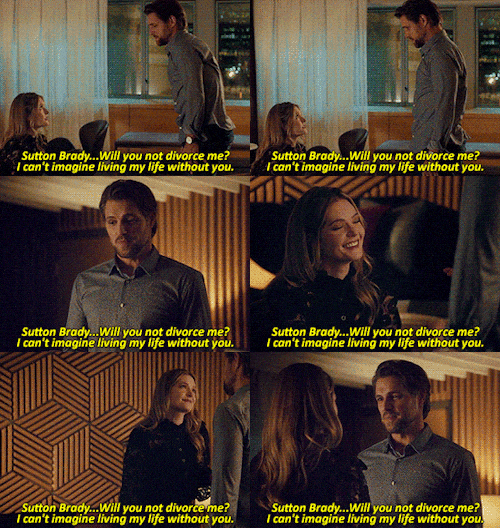
GIF of Richard Hunter and Sutton Brady (Suttard)

But it really is just fantasy. In reality, fairytale endings like this don’t happen. Or if they do, they cause intense resentment and bigger problems down the line.

I admit that I struggle to relate to Richard, personally. As someone who decided early on that I will be childfree for life, I find it very difficult to imagine wanting to have children more than wanting to be with the person I love. (And my god, these two really do love each other. The two actors have incredible on-screen chemistry!)

But many people do feel like that, and it’s valid and real. Many people want to be a parent more than anything, even if it means they can’t be with the person they thought was their forever person. And those people can’t just switch that off the way Richard seems to in this too-neat-to-be-real happy ever after where he decides he wants to be with Sutton after all.

Do Fairytale Happy Endings Exist?

Sadly, no. At least not in the way you’re thinking of.

A much younger, more naive version of me thought that I’d find a fairytale happy ending someday. There have even been moments when I thought I’d found it. But I hadn’t, because it doesn’t exist.

Real relationships require constant communication, ongoing compromise, and re-calibration as you both grow and change. You can decide to be together, to commit, to go all-in, but that doesn’t take away from the very real work required to make love work long term.

Love is messy, love is nuanced, love is the best thing in the world. But it is not magical. It does not remove all obstacles or effortlessly sweep them aside. And some obstacles are too big to overcome. One person wanting children while the other doesn’t? That’s probably one of those obstacles.

So I’ll enjoy Richard and Sutton’s happy ending for what it is: escapist fantasy wrapping up five seasons of escapist fantasy. But I’m glad it’s not real. Because as much as I want someone to love me for the rest of my life, I would never want them to give up their greatest dream to be with me.

I Don’t Want Children (and That Doesn’t Mean There’s Anything Wrong with Me)

I don’t want to have children.

Ever.

I think I was seventeen the first time I uttered that sentence out loud. My then-boyfriend and I had discussed how many children we’d have someday, and what their names would be. Because that’s what you did when you were in a loving relationship, wasn’t it? Get married, buy a house, get a dog, then have children. Even though I have long had complicated feelings about marriage, I’m more of a cat person, and… I don’t want children.

I’d not yet heard the phrase “childfree by choice” when I realised that parenthood didn’t fit with the vision I had for my future. I wanted to write, I wanted to travel, I wanted to adopt animals and make a home with my partner. But could I see myself as a mother? Every time I thought about it, it just didn’t fit.

Why Are People More Concerned About Hypothetical Children Than About My Happiness?

I’ve been polyamorous my entire adult life. Whenever I come out to someone, one of the first questions I get asked is how this will impact my children someday.

Firstly, there is no compelling evidence to suggest polyamorous families are inherently worse for children than monogamous ones (and plenty of evidence to suggest that kids raised in poly households can thrive!) Second, and more important in my case: I don’t want children. I’m never having any, and I don’t date people who have them, so the impact of my polyamory on them is a completely moot hypothetical argument.

I think this speaks to the broader habit of calling childfree by choice women “selfish.”

Since I was a teenager, I’ve been told I’d change my mind and that I was too young to make this choice. (Ironically, I think I will be “too young to make this choice” until the day I become “too old to have kids” in the eyes of society.) The implication is that these hypothetical, unborn, unconceived, never-going-to-exist children matter more than the happiness of an actual living, breathing, already-existing human.

How Being Childfree By Choice Has Impacted My Dating Life

Honestly, it really hasn’t.

I’ve always been very upfront about the fact that I don’t want children at the start of any new relationship, casual or otherwise. This allows prospective partners to self-select out if this doesn’t work for them. I have a strong preference to date other people who are committed to the childfree by choice life, and I won’t have anything but a very casual relationship with anyone who has children or wants them in the future. There is no point wasting each other’s time if our big picture life goals don’t match.

I use two methods of birth control at all time, and I’ve always been very clear with anyone I have potentially pregnancy-causing sex with that an accidental pregnancy will result in a hasty abortion and that this is not up for debate.

How Do I Know I Won’t Regret It?

I know because every time I allow myself to imagine being a parent, I am filled with an immediate and visceral sense of “absolutely the fuck not.”

Can I 1000% guarantee I won’t wish I’d had kids when I’m 70? Of course not. But I think it’s tremendously unlikely, given how much I love my life as it is. I have loving partners, friends, and chosen family. I’m not going to end up alone. And really, is a vague fear of being alone at some unspecified point in the future a good reason to bring a new life into this world? I don’t think it is.

If I pushed myself to become a parent out of some misguided sense of duty or pressure, I think I’d regret that.

Late last year, my nesting partner Mr C&K had a vasectomy. My risk of unintended pregnancy was low already (thanks, Mirena!) but that decision removed any remaining possibility. When it was done, all we vboth felt was an overwhelming, searing relief. No lingering “what if?” No sadness for what might have been. Just, thank God, that’s one less thing to worry about.

I Don’t Want Children, But That Doesn’t Make Me Heartless

“There’s something deeply wrong with women who don’t want children.” I still remember overhearing someone say this, and the countless times I’ve heard similar sentiments. It’s not usually quite as overt as this, but the implicit question underlying all the bullshit that’s thrown at childfree women is “what’s wrong with you?”

Nothing is wrong with me.

I’m not broken. This decision isn’t the result of some unresolved trauma. I’m not missing a piece of my heart. I’m not selfish. I don’t hate children. I’m perfectly capable of love. I literally just don’t want to be a mother. I’m comfortable with that. I wish the rest of the world was.

Is Masturbation Cheating? No, And Here’s Why Not

“Is masturbation cheating?” is a question that comes up surprisingly frequently. A lot of people carry tremendous guilt about masturbating, especially if they are in a relationship, while others feel betrayed by their partner’s solo sex habits and view masturbating as a form of cheating.

What is Cheating, Anyway?

Before we can dismantle the idea that masturbation is cheating, we first need to understand what “cheating” or infidelity actually is.

In most monogamous relationships, cheating is defined along the lines of “doing sexual or romantic things with someone who isn’t your partner.” Of course, this doesn’t hold up for those of us who are polyamorous or in open relationships. In those relationships, doing sexual or romantic things with multiple people is the entire point. However, it’s still possible to commit infidelity, betray a partner, or cheat in polyamorous and non-monogamous relationships.

Broadly speaking, my working definition of cheating is knowingly and willfully breaking the agreements of your relationship in order to engage sexually or romantically with another person without your partner’s knowledge and/or consent.

Masturbating Cannot Be Cheating Because You Can’t Cheat On Your Partner With Yourself

Masturbation is solo sex, or something that you do alone and with your own body. By definition, therefore, masturbation cannot be cheating because it does not involve a third party. You cannot cheat on your partner with yourself.

If touching your own body is cheating, then is taking yourself on a dinner date to a restaurant cheating? After all, you presumably go on dates with your partner. If this argument sounds ludicrous, it’s because the idea that masturbation is cheating is equally nonsensical.

Again: you cannot cheat on someone with yourself.

Is Masturbation Cheating if My Partner is Masturbating All the Time Instead of Having Sex With Me?

It’s true that, in occasional outlying circumstances, a person’s masturbation habits can become compulsive to the point that they interfere with partnered sex. However, this isn’t super common and regular masturbation doesn’t normally have a negative impact on sexual desire for a partner. But even if this is what’s happening, the answer to the question of whether masturbating instead of having sex with a partner is cheating is still no.

Sexual incompatibilities in a relationship can be hard, but they’re a thousand times harder when you don’t talk about them. If you’re dissatisfied with the sexual relationship you have with your partner, you need to have a conversation. You might need to work on increasing intimacy in your relationship, get outside support such as therapy, renegotiate the terms of your relationship, or end it. But it’s still not cheating.

Your partner doesn’t owe you sex, and their right to a solo sex life is not contingent on their providing you with sexual access to them. Forbidding your partner to masturbate might seem like an easy answer if you’re not getting your sexual needs met, but it’s never okay to infringe on your partner’s bodily autonomy in this way. It also won’t actually solve the problem because, in all but the most extreme cases, the chances are that your partner’s lack of interest in sex has little or nothing to do with their masturbation habits.

Is Masturbation Cheating If I Hide It?

No.

Your partner doesn’t need to know about everything you do that doesn’t impact them directly. This includes solo sex. Masturbating privately is not cheating.

Of course, I believe that partners should be able to talk openly about sex, including masturbation. But this doesn’t mean that you need to tell your partner every time you do it, or even specifically notify them that you masturbate at all. The overwhelming majority of people masturbate. We should all probably just assume that our partners are getting themselves off sometimes and that it’s not a big deal.

People in relationships are still allowed privacy, and that privacy extends to masturbation.

Is Masturbation Cheating if I Watch Porn or Fantasise?

Still no.

I understand that people can have strong opinions about porn and other erotic media. And I can understand wanting to be with someone whose views on the subject align with yours. However, I still firmly believe that, as long as you’re using it mindfully, consuming porn or erotica can be a part of a healthy solo sex life that has no negative impact on your relationship whatsoever.

And by the way: porn is not an addiction. Neither is using a sex toy. Neither is masturbation.

Similarly, fantasising is not a problem and having fantasies while masturbating does not constitute cheating. Most of us find people other than our partners attractive or have sexual fantasies that don’t involve our current partners at least occasionally. Fantasy is fantasy, and does not equate to action. Simply put: masturbation to sexual fantasies is still not cheating.

Your Body Belongs To You

You have an absolute, inalienable right to bodily autonomy. Your body belongs to you and nobody else. Always.

And yes, this applies even in a 24/7 Dominant/submissive relationship. You might consensually agree to play with things like chastity or orgasm control because they’re fun, but even a submissive partner can always take back control, renegotiate, or withdraw consent at any time. If you can’t do this then you don’t have a relationship, you have a hostage situation.

You have the right to do what you like with and to your own body. And that includes the right to engage in a sexual relationship with yourself. Even if you’ve agreed to be monogamous, your partner does not own your sexuality. Masturbation is not cheating and you have a right to do it if you want to. Trying to control you to that extent, or limit the ways you can engage privately with your own body, is a major red flag or abuse or coercive control.

[Guest Post] Anxiety and Sex: How Panic Attacks During Sex Led to Me Getting the Help I Needed by Ruby Bell

I knew I wanted Ruby Bell (she/her) to guest blog for me the moment I read one of her several brilliant guest posts for Girl on the Net. Thankfully, she agreed and pitched me this fabulous piece all about anxiety and panic attacks during sex.

Amy x

Anxiety and Sex: How Panic Attacks During Sex Led to Me Getting the Help I Needed by Ruby Bell

My partner has me against the wall. He has me blindfolded and he’s using a very powerful vibrator on my clitoris. These are some of my absolute favourite things… so why am I moments away from having a full-on panic attack? 

Living with anxiety isn’t easy, but it is something we all know a lot more about these days. It’s brilliant that people are talking more about mental health. As a result, many of us are feeling a little less intimidated about sharing our true thoughts and feelings with those we love. Despite all of this progress, it doesn’t make having panic attacks any easier. Having panic attacks during sex is a part of anxiety not many people talk about. It’s certainly not something I ever expected to have to deal with. 

So, let’s talk about some of the science behind the madness of our minds. The release of oxytocin during sex magnifies emotions as well as promoting trust and empathy with your partner. This suggests that it can encourage a release of feelings that may have nothing to do with what is actually going on in that moment. Maybe you’ve had an argument with your mum recently. Maybe you’ve had a fucking awful week at work or maybe your mental health has just generally been suffering lately. Now you’re in this safe place with the person you trust the most, and all of these things are coming out. It’s quite common for some people to cry during sex, and this can easily go from a few tears to a panic attack if you suffer with anxiety or depression as well. 

The first time I had a panic attack during sex was only the second or third panic attack I’d ever had.

This meant I hadn’t yet learnt how to spot the signs of an attack rising or how to calm myself down and prevent it from getting any worse. I barely even knew what a panic attack was! This ended up with me having a pretty out of control, I-can’t-breathe, sobbing-my-heart-out kind of panic attack in front of my (still pretty new at the time) partner… who is standing there enjoying edging me, watching me writhe and squirm with a thick hard cock as he does. 

Fortunately, he dealt with the situation even better than I ever could have asked for. He turned the vibrator off, he removed my blindfold, and when I replaced it with my hands to try and hide my embarrassment he pulled me close to him and held me against his chest. He asked if he had done anything wrong. I sobbed that he hadn’t. I was enjoying it and I didn’t know why this was happening which actually panicked me even more. He told me it was fine. He told me to breathe and he walked me around the house reminding me to keep breathing.

At the time, I thought it was strange and a little comical that two semi-turned-on people were walking around the house together, completely naked for no apparent reason as my face dripped with tears and mascara and my chest heaved with heavy, struggling breaths. I know now that the walking helped to ground me. It helped distract from the panic as well as allowing me to feel close to and loved by my partner. 

I’m lucky. Now that I have worked on my mental health and my panic attacks in particular, if one does start to rise in me I know how to calm myself down. I can reign it in before the main symptoms begin around 90% of the time. But having panic attacks during sex did two wonderful things for me – although I didn’t know there was anything wonderful about it at the time of course.

First of all, it changed the dynamic of my relationship completely.

Up until the point of that first attack, my partner and I were still holding back things during sex. I was being careful not to come across as overly emotional or “crazy.” Looking back, it was probably the reason that first attack happened. I hadn’t been honest with my partner about the feelings I was having in our relationship. And I was hiding who I really was, which is never a good thing.

This panic attack during sex led to me and my partner connecting emotionally on a whole new level. I learned that my partner was not just the tough guy exterior that came across. Showing my own vulnerability and opening up to him allowed him to do the same with me. This led to us having a much stronger relationship in the long run. I now know I can talk to my partner if I’m feeling anxious, depressed, panicked or anything else. I can tell him if I don’t even know what’s causing those feelings and we can deal with it together.

The second thing that first attack during sex did for me was make it clear I did have a problem that needed to be addressed. Up until that point I had struggled with anxiety for years without ever really facing it. I had several extremely unhealthy coping mechanisms which were in fact making things worse. Having my partner walk me around and remind me to breathe led me to learning how to deal with these feelings effectively. From that experience, I learned coping techniques that I still use today. Having that outburst in front of another person meant I had to face what was going on. It meant someone else could see that actually I wasn’t okay, I wasn’t coping. This led to me getting the help and support I so badly needed. It also helped me to work on communication about my mental health overall. 

I hope that anyone else dealing with anxiety or panic attacks during sex – or at any other time – takes it as a sign that they need to deal with the emotions causing these attacks. Listen to the fact that your body has felt comfortable enough to open up fully in front of the person you are making love with. I think we all need to listen more to what our bodies and emotions are telling us. And perhaps if we take the time to stop and listen to ourselves, then there is a good chance things won’t ever need to get as far as a panic attack.

About the Writer

Ruby Bell writes erotica and is passionate about sharing her filthy sexual experiences and fantasies. Her sex-positive writing also includes mental health content, self-care, and educational pieces. She wants to spread both arousal and information! She loves BDSM, chubby women and growing her own herbs and spices.

Vibrator Addiction: No, You Cannot Get Addicted to a Sex Toy

Vibrator addiction (or sex toy addiction more generally) is the less common but equally insidious sibling of “sex addiction”, and it’s equally nonsensical if not more so. I don’t believe sex addiction exists; it’s either a convenient excuse for bad behaviour, or driven by shame (usually religious in nature.) Dr David Ley has done some fantastic work on debunking the myth of sex addiction from a clinical perspective, so do check out his writing if you’re interested in learning more.

But this post is about vibrator addiction, sex toy addiction, and the general concept that you can become “addicted” to a sex toy.

You can’t.

I’m here to clear up this myth once and for all, because I’m sick of telling people that it’s really okay if they use their sex toy every day. Yes, even if it’s the only way they can orgasm. Yes, even if they use it multiple times a day!

First: What Do We Mean By “Vibrator Addiction”

When people talk about vibrator addiction or sex toy addiction, they usually mean one of two things:

  1. They’re scared of becoming so reliant on their toys that they won’t be able to orgasm any other way
  2. They’re worried that there is something wrong with them because of how much or how often they masturbate – that they’re sex addicts, nymphomaniacs, and so on.

Neither of these things is an addiction in the clinical sense, which refers to – according to the Cleveland Clinic – “a chronic (lifelong) condition that involves compulsive seeking and taking of a substance or performing of an activity despite negative or harmful consequences.”

Using a sex toy, even using one very regularly, is not compulsive, nor is it likely to have negative or harmful consequences. Masturbation, orgasm, and sex toys are not harmful (as long as you’re using body-safe toys.) In fact, they can be tremendously beneficial. You can’t misuse or abuse a sex toy in the same way you can, for example, alcohol or drugs.

If you find that you’re regularly masturbating to avoid dealing with difficult feelings, or doing it so much that other aspects of your life (such as work, friendships, or relationships) are being negatively impacted, you might want to consider seeing a sex positive therapist. However, I still don’t believe this constitutes a “sex toy addiction.” It’s also pretty rare. It is far, far more likely that what you’re dealing with isn’t a vibrator addiction, but good old fashioned sexual shame.

Addiction is a serious medical problem with causes major issues for both the sufferer and their loved ones. Addiction can kill. No-one, to the best of my knowledge, has ever turned to crime, alienated their family and friends, lost their job, run themselves into debt, or died because their Magic Wand just felt too good and gave them too many orgasms.

Minimising the very real pain of addiction and co-opting it as a sex-shaming tactic is incredibly insensitive and harmful to anyone who has been impacted by it.

Will I Break, Stretch, or Loosen My Vagina If I Use Toys Too Much?

No.

Genitals are fucking cool, y’all. They do not break or wear out from overuse.

Case in point: Millions of people give birth every year, which puts far more strain on the vulva and vagina than even the most hardcore of sex toys, and those people’s bodies bounce back just fine. I think the myth of toys stretching out a vagina irrevocably is closely associated with the (false and misogynistic) notion that too much sex causes a “loose” vagina. It fails to neglect the medical reality that the vagina is a muscle and muscles Do Not Work That Way.

You cannot break your genitals by enjoying sex toys. You can’t permanently stretch or loosen your vagina. It won’t mold around a toy and become unable to enjoy anything else. It won’t break, get addicted to one single type of stimulation, or become unable to enjoy other types of pleasure in the future. I promise!

Can Using Vibrators Cause Permanent Desensitisation?

No.

There is also no evidence whatsoever that prolonged or repeated usage of vibrators, even really high-powered ones, causes any long-term loss of sensation in the clitoris or vulva. At most, some people report feeling desensitized for a short while after a session of using a toy. This is especially common with buzzier toys, which can cause the dreaded “numbed out clit” effect. However, these effects are short-lived (typically minutes to hours at most) and cause no long-term damage or change in sensativity.

I’ve probably had, on average, something like ten orgasms a week with a vibrator for the last decade. The slightest flick of a partner’s tongue over my clit can still make me shiver. Toys will not harm your nerves or ruin your sensitivity permanently. Really liking using your toys does not constitute a sex toy addiction, and using a vibrator cannot permanently alter your sensitivity even if you use it every day.

Tangential but related: if you experience genital pain after using a sex toy, it could be any of the following:

  • You used a toy made from a toxic material
  • You used a toy made from a material you’re sensitive to
  • You didn’t use enough (or any) lube
  • You used a lube with toxic ingredients (or ingredients you’re sensitive to)
  • You didn’t warm yourself up enough, or weren’t aroused enough before you started
  • It’s just your body’s response to a new stimulus that it’s not used to (a bit like your muscles aching the next day if you do a new form of exercise!)

Do I Have a Vibrator Addition If Using a Toy is the Only Way I Can Orgasm?

I’m going to say something truly radical now. Stay with me.

If using a vibrator is the only or the most reliable way for you to reach orgasm, follow these steps:

  1. Use the vibrator
  2. Enjoy your orgasms
  3. Don’t worry about it

Orgasms are great. We should all be having as many of them as we wish. There are countless ways to reach orgasm. Not all of them work for everyone, and all of them are equally valid. The only requirement for a “good” orgasm? That everyone inducing or experiencing it is consenting. That’s literally it.

Reaching orgasm more quickly with a vibrator is normal. Only reaching orgasm with a vibrator is normal. Using a vibrator every time you want to get off isn’t a “vibrator addiction,” it’s a physical preference.

Some people with vulvas (and their partners) spend their entire lives chasing the elusive vaginal-only orgasm. The reality, though, is that the overwhelming majority of people’s bodies don’t work that way. Many people feel slighted if they can’t get their partner off without the aid of a toy. Some will wonder if their partner’s toy usage is to blame. It’s not; people and bodies are just different.

I encourage everyone to experiment with different kinds of pleasure to find what feels good for them. This can and probably will change over time. That’s normal too. Using toys can broaden, rather than narrowing, your experience of pleasure and the ways in which you can enjoy your body.

But when people message me to ask, “Dear Amy, please help, the only way I can reliably orgasm is by doing this thing”, my answer is very likely to be “….then do that thing.”

I’m Worried My Partner’s Sex Toy Addiction Will Replace Me

A lot of people are afraid that they, or their partners, will find the stimulation they get from a toy to be so overwhelmingly amazing that they won’t have any need for partnered sex in the future.

Again, this fear is not remotely evidence-based. In fact, I’ve found that the opposite is more often true. Many people find that exploring their sexuality through toys increases their potential for erotic enjoyment and therefore improves the partnered sex they have.

A toy, however much you love it, cannot be a substitute for a partner. Companies that use terms like “battery operated boyfriend” or “the perfect lover” to describe toys have a lot to answer for. So does that stupid scene in Sex & the City. Until a toy is sentient, shows up for me emotionally, makes me laugh, snuggles me at night, watches Netflix with me, takes me on adventures and brings me coffee, it is NOT a boyfriend/lover/partner. It’s an inanimate object, a tool through which to experience pleasure.

Don’t shame your partner if they enjoy using toys. Don’t accuse them of having a vibrator addiction, and don’t try to make their toys your competition. It’s not necessary. Toys can’t replace people.

“Vibrator Addiction” is a Misogynistic Shaming Tactic and Nothing More

The false notion of sex toy addiction adds to the stigma of masturbation and sexual pleasure. It’s also rooted in misogyny, since the accusation of having a vibrator addiction is pretty much always thrown at women and people with vulvas. It has no medical, psychological, or evidence-based foundation.

Let’s stop it and allow people to have orgasms in the ways that work for them.