[Guest Post] Nour Hifaoui Fakhoury’s “Titties”: Resistance Against Misogynistic Censorship in the Arab World with Erotic Graphic Novels by J. D. Harlock

Something a bit different today, friends! Writer J. D. Harlock approached me about doing this interview with graphic novelist Nour Hifaoui Fakhoury about her new erotic graphic novel, “Titties.” It’s a fascinating read and I can’t wait to read the comic, too.

Amy x

Nour Hifaoui Fakhoury’s Titties: Resistance Against Misogynistic Censorship in the Arab World with Erotic Graphic Novels by J. D. Harlock

Nour Hifaoui Fakhoury is a SWANA graphic novelist who, after graduating from the Lebanese Academy of Fine Arts (ALBA) in 2015, sought to immerse herself in the world of visual storytelling. Following years of honing her craft in the Lebanese art scene, Nour joined Samandal Comics, a SWANA comics collective in Lebanon dedicated to developing the medium of comics in the Arab World. Currently, her work is primarily focused on autofiction, which presents intimate stories with an exaggerated art style in hopes of accentuating them.

Recently, Nour agreed to sit down for an interview to discuss her semi-autobiographical erotic graphic novel Titties. Titties explores the tumultuous sex life of a character loosely based on the author in one-page stories recounting adventures with various sexual partners. By presenting these encounters in an unapologetically explicit manner, Nour hopes to provoke the reader to confront the uncomfortable realities prohibition, repression, and marginalization of sexual experiences. Ultimately, this fearless act of transgression is all in service of pushing the limits of self-expression in Lebanon, where censorship is increasingly present, with few options left to resist the status quo. 

Here are some highlights from my conversation with Nour.

Cover image of the graphic novel Titties by Nour Hifaoui Fakhoury. A cartoon of a woman reclining on a red bed with her hands behind her head. She is naked apart from a pair of red panties.

J. D. Harlock: As someone who’s been blessed to have spent his entire life in Beirut, it pains me to say this, but the Arab world isn’t known as a hub for graphic novelists, such as yourself, Nour. Even if titles are available in bookshops in Lebanon, the selection is typically limited to a select few titles from countries like the US, France, Belgium, Japan, and the UK. Speaking from experience, it’s almost impossible for a local to read enough to learn the craft without spending a fortune or sailing the high seas of digital piracy. In addition to my excitement when I meet a fellow comics fan from this part of the world, I’m always curious to find out how they became fans of the medium in the first place. So Nour, tell us how you first came to experience the exhilarating world of sequential art?

Nour Hifaoui Fakhoury: When I was a child, a French comic artist whose name I can’t recall came to our school for a presentation. What intrigued me was the notion that you could draw the same character over and over for pages to tell a story. Back then, people used to call me “Miss Curious” because I would ask too many questions about people’s lives. I wanted to hear their stories, the intimate ones—the ones they wouldn’t share over coffee with a neighbor. It is as if I wanted to know the origin stories of people, where they come from, and how they became who they are.

Of course, this desire is directly connected to Palestine, where lies my own origin story, which I’ve unfortunately never had the chance to explore in person due to the Zionist occupation. Since words were never my strong point, I’ve always had difficulties expressing myself through writing. Doing it through drawing, however, was seamless. Even when I hear a song, I rarely focus on the words, but feel the feelings in the images.

So, between my love for stories and my connection to drawing, it was evident I’d specialize in it. Of course, now I’ve also tamed the world of words, and I use them more and more in my dialogues and descriptions. However, when I first started illustrating comics, most of them were silent.

J. D. Harlock: How did you end up joining Samandal Comics?

Nour Hifaoui Fakhoury: My introduction to Samandal Comics happened while I was at university. I discovered their publications for the first time and realized that there was a comics scene in Lebanon with an audience for adult comics. Eventually, I met Lena Merhej, one of the founders of Samandal Comics, while working on an anthology in which we both have stories featured. A year later, Samandal member Joseph Kai invited me, Karen Keyrouz, and Tracy Chehwan to join the collective and have our generation take the lead. Without hesitation, I agreed.

J. D. Harlock: And why did you choose Samandal to be the publisher of Titties?

Nour Hifaoui Fakhoury: I chose Samandal to be my publisher because I wanted my story published and read in Lebanon by Lebanese people. However, when it came time to print the comic, the printing house had reservations about the content. It was too explicit and daring. My second option was to print it with our collective in France and then distribute it in Lebanon, which is what I ended up doing.

J. D. Harlock: What inspired your erotic graphic novel Titties?

Nour Hifaoui Fakhoury: I recently read several comics by Ulli Lust and Julie Doucet. I loved their narrative style—works of autofiction revealing so much vulnerability and crudeness while simultaneously depicting relationships with intimacy. These comics made me reflect on both my narrative style and my relationships.

Meanwhile, I was in an open relationship for the first time, and I was hooking up with several people at the same time. Navigating that experience for the first time in my life was eye-opening. After each sexual encounter, I started drawing pages as if to process what had happened, and I would share them with friends as a way to recount to them what was happening and have a laugh. After a few months of doing so, I realized that I had what could become a comic.

J. D. Harlock: Given the subject matter and how conservative certain segments of Lebanon are, were you worried about any potential backlash from its release?

Nour Hifaoui Fakhoury: Of course, I was worried, but I also knew that this comic would be distributed in safe spaces. As for my parents and family, I knew they wouldn’t read and see it. They are absolutely not my target audience. However, both my parents knew I was publishing it. Obviously, my mother wasn’t pleased, but she understood that this was my life and my work. She knew how to detach herself from it. On the other hand, my father has no clue what’s inside the comic; he only knows it’s a feminist work exploring women’s sexuality.

J. D. Harlock: So, how would you describe the response to the release of Titties so far?

Nour Hifaoui Fakhoury: The response was wonderful. Initially, we printed a small batch to see how readers would react. It sold out right away, so we printed several more editions and all of them sold out, too! A friend of mine had to buy more than ten copies because each time his visitors saw it, they’d snatch it off his shelf! Eventually, it reached the shores of Italy. An Italian publisher translated it into Italian and sold copies of it there, too.

J. D. Harlock: What were you hoping to achieve by sharing these experiences?

Nour Hifaoui Fakhoury: I wanted to normalize discussions of sexuality and sexual orientation in Lebanon so that we can be open to experimenting and exploring our kinks. Readers were meant to laugh with the protagonist, shattering the taboos that repress our sexual experimentation. I hoped to accomplish this through the “female gaze,” which is frankly lacking in Lebanese literature.

I also wanted to connect sex to the external world—politics, nonsexual traumas, and their impact on the body and desire. We tend to think of sex as a purely sexual act. But it is informed by everything that surrounds us.  There is no way to tell if this is what my readers got out of reading Titties, but I received great feedback from readers. I hope this story impacted them the way I hoped it would.

J. D. Harlock: Do you plan to release more work in the vein of Titties in the future?

Nour Hifaoui Fakhoury: Yes, I am currently working on the second tome of this comic, Titties Too, in which the character explores her bisexuality or pansexuality also through an open relationship. At the same time, I’m also working on an erotic lesbian graphic novel called Labrys with a Belgian publishing house that’s even more visually explicit, in which the characters are in a long-distance relationship. With this graphic novel, I hope to explore long-distance sexuality facilitated by new technologies such as vibrators connected to phones.

J. D. Harlock: And that’s a wrap for now! Thank you for your time, Nour. As always, I’m looking forward to reading these graphic novels—as I usually am with all of Samandal Comics’ releases when they first hit Lebanese shelves. And I hope we can have another interesting deep-dive about them when the time comes!

About the Writer

J. D. Harlock is an Eisner-nominated SWANA American writer, researcher, editor, and academic pursuing a doctoral degree at the University of St. Andrews. His writing has appeared in Business Insider, Newsweek, The Cincinnati Review, Strange Horizons, Nightmare Magazine, The Griffith Review, Queen’s Quarterly, and New York University’s Library of Arabic Literature. You can find him on LinkedIn, Bluesky, Twitter & Instagram.

[Book Review] Monogamy? In This Economy? by Laura Boyle

“Monogamy? In this economy!?” has become a bit of a meme or running joke in the polyamorous community recently. The idea, of course, is that amidst a cost of living crisis it can be more cost-effective to live in a household of multiple adults.

Obviously this is very tongue-in-cheek. No-one would seriously suggest mass polyamory as a long-term solution to one of the worst financial crises in living memory. However, it also speaks to a real truth: some polyamorous people choose to live together and combine finances out of genuine desire, others do it out of economic necessity. And honestly, for most people (regardless of relationship style), the choices we make around nesting, money and childrearing are probably driven by a combination of those two factors.

Taking on this theme, Laura Boyle (author of Ready For Polyamory and creator of the Ready For Polyamory blog) brings us her new book: Monogamy? In This Economy? Finances, Childrearing and Other Practical Concerns of Polyamory.

What’s It About and Who Is It For?

The subtitle pretty much says it all. Stepping away from the “Polyamory 101” and “how to have healthy polyamorous relationships” style of guidebook that is so prolific, Boyle has instead chosen to focus on the practicalities of actually living a polyamorous family life in a world designed for monogamy. How do polyamorous people live together, and where? What if you want to live with your partner but can’t stand your metamour? How do polyamorous families manage finances? What about the children? All these, and more, are questions that countless polyamorous people have been asked and have asked ourselves. Boyle aims to tackle them and many more here.

In preparation for writing this book, Boyle interviewed over 400 polyamorous people. These people live in virtually every permutation of “three or more adults in one household” that you can imagine. I’m frankly in awe of the research that has gone into this book and the hours it must have taken.

Boyle is US-American, and her book does naturally have a slant in that direction. Some of her research participants are located outside the US, though. Those individuals’ and families’ experiences provide useful insights into how geography, local laws and cultural norms can have an impact on polyamorous families.

Overall, you will probably find this book to be of the most practical benefit if you live in the US. However, there’s also plenty there for those of us doing polyamory in the rest of the world. In short, it’s for anyone who is polyamorous (or poly-curious) and wants to learn about how polyamorous people navigate the realities of 21st Century life.

What’s Covered

Boyle begins by briefly introducing polyamory, the concept of polyamorous families, and the methodology behind her survey in chapter 1. In chapter 2, she explores the different formats that polyamorous households can take as well as the challenges that issues such as property zoning and limitations presented by mortgage and leasing laws. Chapter 3 is all about the sometimes-thorny (and emotive) issues of beds and bedrooms, as well as adjacent issues around closet space, household chores, and bathrooms.

Chapter 4 addresses preconceptions about polyamory and the ways they can impact polyamorous families. It also tackles problems in relationships and the ways these can spill over to impact the entire network, and the unique challenges that living in small spaces can present. Chapter 5 covers making your home your own, with tips on how to ensure that everyone feels welcome and at home in the shared family space. I found the insights around understanding how your family actually uses space to be particularly insightful. Chapter 6 is all about metamours, from scheduling conflicts to navigating privacy in shared spaces. It also covers managing jealousy when you all live together.

In chapter 7, Boyle delves into all things money. She discusses navigating finances as a polyamorous family, learning how to talk about money openly, and coming to agreements about non-essential spending. Chapter 8 is all about children and childrearing, including talking to your kids about polyamory and your nesting plans, understanding and dividing up parenting responsibilities, and the additional challenges that arise as children grow into teenagers and young adults. The parenting theme continues in chapter 9, which covers issues such as family planning and unplanned pregnancies in a polyamorous context as well as polyamorous situations where not all partners are parents.

Chapter 10 is about break-ups, denesting, and ending or de-escalating cohabiting relationships. And finally, chapter 11 continues the break-ups theme but switches the focus to breaking up or deescalating while coparenting.

You can either read the book cover to cover for a comprehensive overview of some of the many ways to navigate the practicalities of life while being non-monogamous (and an intriguing insight into the many ways other people do it), or you can dip in and out to the bits that are most pertinent to your current situation and needs.

Writing Style

Like her first book, Boyle’s writing style in Monogamy? In This Economy? is chatty, accessible, and non-judgemental. She validates common concerns and normalises problems that polyamorous families may face.

Monogamy? In This Economy? is not a blueprint or an instruction manual. Instead, it explores the various different options available to multi-adult households. Boyle doesn’t tell you what to do, but offers insights into some of the many potential solutions to common challenges.

All the way through, Boyle’s insights are peppered with real-life stories from some of her hundreds of interviewees. These bring the theory to life and show some of the real-world challenges, joys, and problem-solving that takes place in polyamorous families.

I found this book to be a fairly quick read, with mostly relatively short chapters. Plenty of subheadings break it up into bite-sized chunks. They also make it easy to find the exact information you’re looking for. Boyle covers a hell of a lot of ground in this relatively concise book. She also signposts to other resources where appropriate.

Verdict & Where to Buy

I’m so glad that this book exists! Whether you are living together with multiple partners or metamours already, considering doing so, or are just curious about some of the possible solutions that are available, this practical and accessible guide will help you to navigate the inevitable challenges.

Well-researched, pragmatic, and reassuring are some of the words that come to mind to describe Laura Boyle’s second book. I currently only nest with one partner and have no plans to change that, and I’m not having children, so you could say it isn’t really for me. However, it’s still given me a huge amount to think about.

Monogamy? In This Economy? will be released on 21 August 2024. Support my work at no additional cost to you by ordering from Bookshop using my links. You can also ask your local indie or LGBTQ+ bookstore to order it in for you.

Thanks to Laura Boyle and her publisher for sending me an advance review copy of Monogamy? In This Economy? All views are, as always, my own.

[Book Review] How Do I Sexy? By Mx Nillin Lore

I’ve known Mx. Nillin Lore (they/them) a little bit through the online sex writing community for some time, and have long admired their views, writing style, and queer, trans-centric approach to sex education and advocacy. So when they told me they were writing a book and approached me to review it, of course I was going to say yes.

How Do I Sexy? A Guide for Trans and Nonbinary Queers by Mx. Nillin Lore is both a practical guidebook for queer, trans and non-binary sexuality and a kind of manifesto for how sex, intimacy, and the concept of “sexy” could be if we all looked beyond the cisheteropatriarchal norms we’ve been fed from birth.

Nillin asks, “what even is ‘sexy’ and how do you do it?” This book is their attempt at answering that question. The book also includes a forward by Sophie Labelle, best known for her webcomic Assigned Male. Sophie also designed the book’s playful, inviting cover.

What the Book Covers

You’ll find both theoretical and practical content in How Do I Sexy?

The first chapter explores the “Ventura Effect,” or how the transphobia in the 1994 movie Ace Ventura: Pet Detective played a role in keeping Nillin in the closet until they were in their mid 20s – and, more broadly, the role that transphobia and queerphobia in popular media plays in shaping queer youngsters’ views of themselves and a cultural landscape that often includes bullying, harassment, discrimination, dehumanisation, violence, and even murder.

Chapter 2 unpacks the idea of “sexy”. What is it? Why is it so limited by mainstream beauty norms? And what are just some of the myriad things people can find sexy? It also covers self-image, embracing oneself as a sexy and sexual being, finding what makes you personally feel sexy, and unpacking all the different kinds of attraction that exist.

Chapters 3 and 4 start to delve more deeply into practical and actionable advice. Chapter 3 deals with the fear, shame, guilt and insecurity that many of us struggle with around our sex lives, desires, genders, and sexualities. It offers both validation and practical strategies on how to start tackling your critical inner voice and the internalised beliefs that aren’t serving you. Chapter 4 invites you to come up with personal mantras that summarise your core values around sex and sexuality. These will serve as guiding lights for how you want to live your best sexy life.

Chapter 5 covers traditional gender roles and society’s toxic ideals, from passing pressure for trans people to the relationship escalator. It offers insights into the negative ways these realities impact queer and trans people. There’s also advice and encouragement on overcoming and consciously rejecting them.

Chapter 6 covers outward presentation and the different ways people might dress and present to feel sexy and affirmed. You’ll find information on affirming prosthetics, underwear and lingerie for trans folks, using makeup for self-expression, and detailed advice on measuring yourself for well-fitting clothing as well as just some of the archetypes and variations of LGBTQ+ self-presentation that are available to pick and choose from. It’s definitely given me some inspiration and ideas for new looks and styles I might like to try.

Chapter 7 covers the nuances of dating, flirting, and finding community. These things can be wildly different when you’re queer or trans (or kinky or non-monogamous). As such, a lot of the typical mainstream dating advice doesn’t really apply. From navigating dating apps and staying safe when meeting people to bigoted “preferences”, flirting tips, and handling rejection.

Chapter 7 is all about queer-affirming sex and how to have it. You’ll learn what it means to be queer and trans-affirming in your sex life and relationships. You will also hear about just some of the many, many sexual and intimate activities that many queer and trans folks enjoy. This includes kink and BDSM dynamics as well as different ways to explore intimacy without necessarily involving sex. You’ll learn about some of the countless terms for body parts and how to find the best ones for you. Finally, Nillin talks about finding – and making – queer and trans porn and erotic content.

The book concludes with a short roundup of 8 important takeaways.

Style & Accessibility

Nillin’s writing is vulnerable and honest. They don’t shy away from sharing their own experiences and the struggles they’ve faced through systemic transphobia, queerphobia, fatphobia, erasure, and more. They share personal stories from their own lived experience and relate them seamlessly to their wider narrative and overarching points. And they unflinchingly own up to mistakes they’ve made and things they’re not proud of, acknowledging how those things played a role in the story of who they are now.

Reading Nillin’s writing is like talking to that wise, slightly more experienced friend that I wish all queer people had when they first come out. The writing is engaging and accessible, occasionally funny, occasionally raw, and always tender and caring. Compassion is central at every stage, and the advice feels like invitation rather than instruction.

Nillin also includes other queer and trans folks’ voices and perspectives. In chapter 2, for example, they ask various friends and industry colleagues about what sexiness means to them and how they relate to it. They also include images from the Crash Pad Series of queer+ erotic films to illustrate various sections of the book.

The book does assume some basic grounding in LGBTQ+ terminology. There’s a handy glossary at the back for any terms you don’t understand, though. And, of course, you can always just look them up online as you read.

Verdict & Where to Get Your Copy

How Do I Sexy? isn’t just a good book, it’s a vital and sorely needed one. LGBTQ+ young people are still rarely represented in mainstream sex education. Many of us make it to adulthood with very little knowledge of our bodies, our sexualities, and how to engage intimately with others. This book is like a warm, comforting hug that says “hey, you’re lovable – and sexy – exactly as you are!”. It’s both a celebration and an invitation.

No matter where you are in your queer, trans or non-binary journey, there will be something in here for you. I’ve been writing, reading, learning and teaching in this space for years and I’ve still learned tonnes from Nillin’s words. Read it from cover to cover for the full experience, or dip into the bits that feel most relevant to where you are now.

How Do I Sexy? by Mx. Nillin Lore will be published by Thornapple Press one month today – 23rd August 2024 – and you can pre-order your copy now. If you order through my Bookshop.org links, I will make a small commission at no additional cost to you. You can also ask your local indie bookseller or LGBTQ+ bookstore to stock it (fuck Amazon amirite?) (But if you’re going to use Amazon, please use Thornapple’s affiliate links. This will send a little more money back to an indie press and its authors.)

Thanks to Mx. Nillin Lore and their publisher for sending me an advance review copy of How Do I Sexy? All views are, as always, my own.

[Book Review] Ready for Polyamory by Laura Boyle

Books on polyamory are a mixed bag. From classics like The Ethical Slut to last year’s psychology-driven Polysecure and Dedeker Winston’s female-driven The Smart Girl’s Guide to Polyamory, there’s a lot of good stuff out there. There are also texts that encourage or enable harmful behaviours, as well as those that are fine but promote a very specific agenda or relationship style.

You might think that, as someone who has been doing various forms of consensual non-monogamy for about 13 years at this point, I’d be at the point where I no longer have need for the books. You’d be wrong, though. Sure, the 101-level texts aren’t really for me any more, but even then they often introduce me to a useful concept or framing I hadn’t previously considered. And the more advanced, specific, or in-depth works that are now available are incredibly valuable, no matter how long I do this.

All this to say that when Laura Boyle of the Ready for Polyamory blog asked me to read and review her new book of the same name, I was only too happy to agree.

Ready for Polyamory by Laura Boyle

Coming in at a hefty 231 pages, Ready for Polyamory is a guidebook to many of the different aspects that go into having happy, healthy, and functional consensually non-monogamous (CNM) relationships. It is divided into four sections:

  • Basic Information is a kind of polyamory 101 – what it is, a very brief history of the term and the communities surrounding it, and the kinds of relationship agreements that tend to work well (and don’t).
  • Find Your Flavor of Polyamory unpacks popular terms such as “Kitchen Table polyamory”, “parallel polyamory”, and “relationship anarchy”, discussing how each one works and exploring the pros and cons of the various models.
  • Conversations to Have and Mistakes to Avoid delves deeply into some of the language that can help you, your partners, and prospective partners to talk about your relationships and your needs. It also explores some productive and destructive ways of behaving in relationships, as well as including a pretty comprehensive chapter on sexual health.
  • The Big Feelings covers all those big, scary, overwhelming, and even wonderful emotions – jealousy, compersion, and cultivating chosen family through your polycule and intentional relationships.

Like many books in this genre, it’s very much a dip-in-and-out structure. If you’re brand new or looking for a comprehensive resource, I do recommend reading it cover to cover (which I did!) But if you’re looking for information on a specific area of CNM – for example, sexual health, setting boundaries, or cultivating compersion – you can easily just turn to the chapters that speak to you.

Ready for Polyamory is written in a chatty, conversational tone. Reading it feels a little like sitting in a room with the author, sharing a cup of coffee and listening to her talk. If you read the blog and enjoy the accessible language and friendly tone, you’ll probably enjoy the book, too.

Choose Your Own Adventure (With the Help of Some Hard-Won Wisdom)

While I don’t agree with absolutely everything Boyle says in this book (which would be hard, because there’s a lot of information here!), I often found myself nodding along to her insights and underlining key passages to come back to later.

Throughout the book, she uses a recurring metaphor that really stuck with me: polyamory as a choose-your-own-adventure story. Instead of prescribing a specific way of operating or insisting on One Twue Way, she offers an array of options and trusts the reader to use the information wisely to make the choices that are best for them and their partners. In a community that is becoming increasingly dogmatic in really concerning ways, this was deeply refreshing.

This is also why I particularly appreciated the inclusion of the Find Your Flavor of Polyamory section. Many people feel very strongly that their way of doing things is the best and right way (“parallel polyam is only for when you hate your metamours!” “Relationship Anarchy is the only ethical relationship structure!”) Boyle shares experiences and lessons from her own life and the lives of people she knows, and leaves you to make your own mind up.

As an experienced polyam person, I found myself wryly nodding along to a lot of the sections about common mistakes and pitfalls. Because society is so heavily set up for the cishetero monogamous default, there are virtually no cultural scripts for polyamory yet… and those that do exist tend to be pretty dysfunctional. As a result, most of us start our non-monogamy journey from a well-intentioned place, but end up hurting ourselves and others along the way, often with the same set of mistakes.

Boyle presents compassionate and experience-based arguments for why many of the most-made polyam mistakes – from the One Penis Policy to unicorn hunting – create problems, and she offers alternatives to help readers make better decisions.

A Pragmatic Guide

Ready for Polyamory‘s subtitle is “A Pragmatic Guide to Consensual Non-Monogamy”, and I think that’s a good summary. Boyle avoids making judgements, slapping down moral absolutes, or prioritising ideological purity. As a result, this book feels like – for want of a better description – a polyamory guide for the real world. A world in which feelings are messy, people mostly mean well but inevitably screw up, and sometimes pandemics throw a huge spanner in the works of your dating life.

Overall, Ready for Polyamory is smart, accessible, and practical. If you’re dipping a toe into CNM or just considering opening up, this book deserves a place on your reading list.

Ready for Polyamory is available in paperback for $17.99 and as a Kindle ebook for $10.01, sold via Amazon. For my UK readers, it’s available on Amazon UK for £13.07 in paperback and £7.26 in ebook.

This review was sponsored, meaning I was paid to read the book and provide a fair and honest review. All words and views are, as always, mine. Affiliate links appear within this post but do not include the Amazon links to Ready for Polyamory.

[Book Review] “Position of the Week” from Lovehoney

Happy Friday, friends! And welcome to day 4 of #12DaysofLovehoney, where I am bringing you a new product review every single day. Check out the whole series. Today we’ve got something a bit different. Instead of a toy, we’re looking at the Position of the Week book from Lovehoney.

What is Position of the Week?

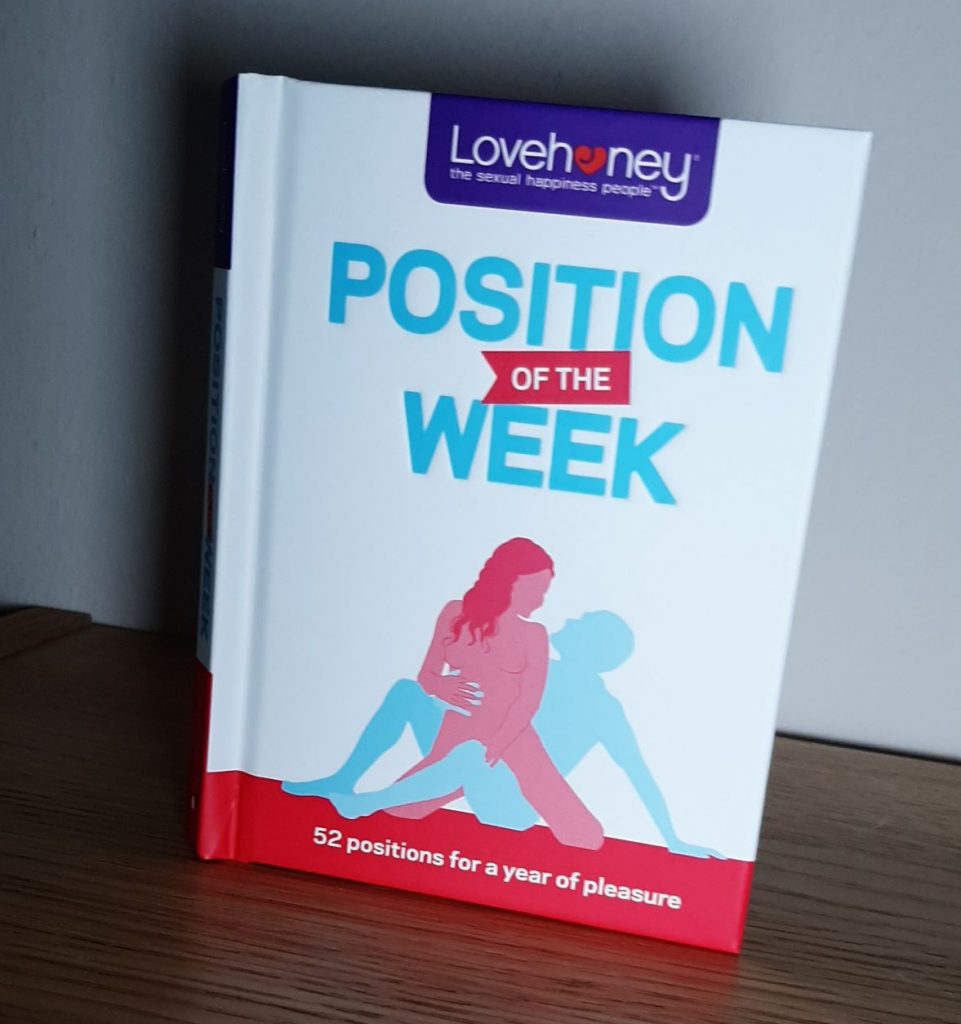
Position of the Week is a book of 52 sex positions (the idea being that there’s one for each day of the week – “52 positions for a year of pleasure,” as the cover says.) It’s a pocket-sized hardback book.

Position of the Week book

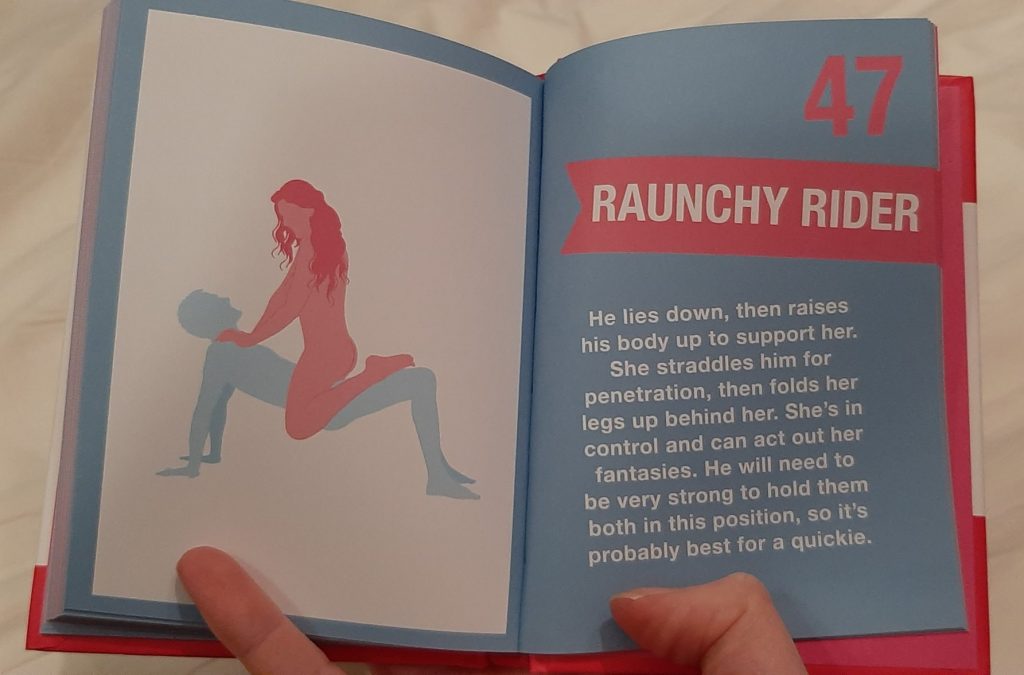
Each double-page spread includes a silhouette-style drawing of a couple having sex in the given position on the left page. The right page gives the position number, name, and a brief description.

Who is it for?

I have to be upfront: this book is very, very heterosexual.

Every position is designed with a cisgender male/female couple having penetrative (penis-in-vagina) sex in mind. The illustrations even feature a woman drawn in pink and a man drawn in blue. There’s also a lot of gendered language throughout (“he does X, she does Y”, “girl power”, and so on.)

Seriously, it’s so freaking straight I can feel my bisexuality leaking out all over its pages.

Pages from the Position of the Week book

Now, a lot of the positions in this book would actually work for different body and genital configurations. Many of the positions would work just as well for two vulva owners using a strap-on, or for anal sex with any configuration of bodies.

So queer and trans folks absolutely could use it. But the language and the whole aesthetic is so cishetero that it’s likely to feel alienating. I feel pretty put off by it and I’m a cis woman in a relationship with a cis man (though I am not straight.)

So yeah. This is a book for cishetero couples who have p-in-v sex. Let’s go with that.

On the 3rd page, after the welcome but before the positions start, you get a little consent disclaimer. This states that you should talk before trying something new, that everything must be 100% consensual, and that you should stop if anything hurts or is uncomfortable.

It’s pretty much Consent 101 summed up in 33 words. But you know what? I’m here for it. Because fundamentally, this book isn’t for people like me – sex nerds who engage in non-traditional relationships and have long and nuanced conversations about sexuality out of academic as well as personal interest. This book is for people who are likely newer to sexual experimentation – many of whom might understand that consent is important, but not have a sophisticated understanding of exactly what that means or how to talk about it.

Basically, what Lovehoney have done with this little one-pager helps to normalise and demystify consent conversations. And I’m very here for that.

So what about the actual positions?

A lot of them are pretty good! We have some obvious-but-decent choices (doggy style, sit-down sex, spooning) and some creative interpretations on classics like reverse cowgirl and standing sex.

Others were definitely created for the athletically-inclined. No. 30 (“the Can-Can”) requires the vulva-owning partner to be able to get their foot on their partner’s shoulder while standing. That is… simply not going to be possible for a huge number of bodies, including mine!

Pages from the Position of the Week book

Positions like the “Standing Thrust” and “Up Against It” require the penetrating partner to be able to support most or all of their partner’s weight while thrusting. Again: just not going to happen. And I’m going to go ahead and call No. 47 (“the Raunchy Rider”) physiologically impossible for 99% of people.

Pages from the Position of the Week book

This book clearly assumes that women are tiny, petite, and flexible, while men are muscular and strong. If that’s not you, it can lead to some pretty negative body feelings.

On the plus side, a number of the position descriptions reference clitoral stimulation, which the vast majority of people with vulvas need in order to get off. So that’s something.

So do I recommend it?

Meh.

If you’re cis, heterosexual, skinny/strong, and athletic, you’ll probably get something from it. Otherwise, you might find a few interesting position ideas but largely be left thinking “…yaeah but my body doesn’t work that way.”

Position of the Week retails for £6.99 from Lovehoney ($8.99 US). A fun stocking-stuffer if you’re within the very specific demographic it caters to! Otherwise, don’t bother.

Thanks to Lovehoney for sending me this product to review! Views are, as always, my own. Affiliate links appear in this and all toy review posts. Want to support the blog? Buying me a coffee is a great way to do that!

[Book Review] Pain Play for Everyone by Luna Caruthers

Luna Carruthers has been running Submissive Guide, a large website of resources for anyone identifying as a kinky submissive (or thinking they might be one), since 2009. I actually found the website way back when I was new to BDSM and found it tremendously valuable. It’s been years since I visited the site, so getting reacquainted with it while reading Luna’s new book, Pain Play for Everyone, was a fun trip down memory lane!

Pain Play for Everyone by Luna Carruthers book cover, featuring a pink background and picture of a paddle.

Pain Play for Everyone by Luna Carruthers is a quick read at 102 pages in length. But there’s a lot of useful information packed into this slim volume.

Pain Play for Everyone: A Book for the Receivers Rather Than the Givers

If you want to be the person dishing out the pain in a kinky scene, this book is not going to teach you the practicalities or necessary safety tips on how to do that. There are great resources available that teach you how to do that, and I encourage you to check them out.

Pain Play for Everyone is very much geared towards the submissive or receiving partner. I liked that about it. So much BDSM content is written by and for Dominants, possibly due to the assumption that us submissive types just lie there and get stuff done to us. (Which is nonsense, by the way.)

But I’ve long held that bottoming well is a skill, and one that deserves to be taught – and celebrated – as much as topping. Therefore I’m delighted to see a book written by a submissive, for submissives.

However, though it’s aimed at submissives and bottoms, I actually think Dominants and Tops should read this book, too. The hallmark of a great Dominant is being able to understand and empathise with their submissive’s experience. By understanding why masochists enjoy pain and how we experience and process pain, sadists can become better, more empathic, and safer players.

Accessible and Easy-Reading Guide

Luna uses accessible language throughout the book, making it easy to read and absorb the information. She simplifies complex concepts and brings them into the realm of real-life kinky play situations, allowing readers to quickly apply the theory to their own kinky lives.

The book is well-structured with clear headers for each section that make it easy to find what you’re looking for.

Practical Tips

Luna shares a number of practical strategies for increasing pain management and pain processing ability during kink play. The strategies are clearly described in detail, making them easy to try out and implement. They won’t all work for you, because everyone is different. But by trying a few different options, you’re likely to find something that is helpful for you.

An Experience-Informed and Well-Researched Guide

Luna uses her own experiences throughout the book to help explain the points she makes and illustrate them with examples. By sharing her real-life experiences, she brings the content out of the abstract and into the real.

Pain Play for Everyone seems solidly researched and delves into a little of the neuroscience, psychology, and physiology of pain processing.

I would have liked to see a bibliography or footnotes referencing sources for some of the more science-heavy bits. But that’s because I’m a massive geek and want to go and read more. There are a couple of links to relevant studies and book suggestions included, but I would have liked to see a much more extensive list of sources.

Who is Pain Play for Everyone For?

I’d definitely have found this book useful when was a new submissive and just starting to explore pain play. Most of it was stuff I already knew, given with my well-over-a-decade-at-this-point of experience.

I still got something out of it, though. I particularly found the descriptions of the various types of pain – beyond thud and sting – to be useful. It also gave me a couple of new ways of thinking about processing intense sensation during a scene. But as a broad generalisation, it’s more likely to be useful to newer kinksters than experienced players.

If you’re new to submission or being on the receiving end of sadomasochistic activity, there will be something for you in this book. In particular, you might find it useful if you are looking for ways to increase your pain tolerance or play at a higher level of intensity.

Where to Buy It

Buy it directly from the author. Or Amazon, if you really must.

I received a copy of this book free of charge in exchange for an honest review. All opinions are my own.

5 Reasons Why I Read Erotica (and You Should Too!)

When I first started this blog, it was not cool to admit to reading erotic stories and enjoying them. Historically, erotica got a bad rap. Anything connected to sex tended to be – and occasionally still is – treated as dirty or shameful. Even now, as a pastime that is disproportionately enjoyed by women, reading so-called “spicy” books and writing erotic stories is often seen as something silly and frivolous.

At the time of editing, it’s been 14 years since Fifty Shades of Grey made E.L James a household name, but people were still trying to convinve each other they read this inexplicably-bestselling drivel for the gripping plot well into the 2020s. This post, in its original form, was a kind of defence of erotica. Over the last few years, though, the rise of phenomena like “romantasy” and #BookTok have made erotica well and truly mainstream.

Despite the Fifty Shades effect and still-pervasive stereotypes, not all erotica is abusive billionaires masquerading as Doms. Not all erotica is bad fanfiction. In fact, there are some truly wonderful smutty stories out there and I firmly believe that reading erotic fiction can be good for you. Masturbation is healthy, pleasure matters, and I am thrilled that erotica is having a mainstream moment. Here’s why.

Reading Erotic Stories is a Safer Way to Explore Fantasies and Limits

Reading about something is generally infinitely safer than doing it.

If you have a kink, fantasy, or sexual interest you can’t or don’t want to explore in reality, reading erotic stories about it can be great way to scratch that itch. You can’t get hurt by reading about something. No-one else’s consent is required. And no, it’s not cheating.

Reading about various kinds of sex is also a good way to discover your kinks, understand more about your internal erotic landscape, and explore in a low-pressure setting if you’re not sure whether something will work for you or not.

And in case you’re wondering: yes, it’s fine (and normal) to get turned on by something in fiction that you wouldn’t want to actually do in real life.

Fiction Can Introduce You to New Erotic Ideas, Archetypes, and Roles

I was reading erotic fiction with dominance and submission themes long before I was practicing BDSM in real life. Erotica helped me to discover the types of scenarios that interested me, the names and words that turn me on… and also the things that completely leave me cold. Reading and enjoying sapphic erotica was also a huge part of coming to accept my own queerness.

Erotica can introduce you to kinks you never knew existed, make you feel less alone in your sexual interests, or even help to open up lines of communication about kinks, fantasies and erotic ideas with your partner (more about that in a minute.)

For women, queer folks, trans people, kinksters, and anyone else whose identity is marginalised, spicy books or erotic stories online may be the first place we ever see sexuality like ours represented.

It Can Turn You On and Get You Off (Obviously)

This is perhaps the most obvious reason to read erotic stories, but it’s also still surprisingly taboo to say. Enjoying sexual arousal and pleasure for its own sake is a good thing.

For people with responsive sexual desire, erotic stimulus (such as making out or talking dirty with a partner or consuming erotic content) can not only heighten desire, but may be necessary to creating it in the first place. Whether you’re looking to turn yourself on for a lengthy solo or partnered sex session or have a quick orgasm before you go to sleep, erotica can help get you there.

Reading or Sharing Erotic Stories Can Improve Sexual Communication

Sharing the erotica you enjoy can be a great way to share what turns you on with your partner. Perhaps saying out loud that you want to be submissive in the bedroom feels scary, but pointing them to a story with those themes feels like an easier way into the negotiation.

Reading erotica together, or even reading it aloud to each other, can also be an incredibly hot time.

And, Yes, the Plots Can Be Good!

I don’t (usually) read smut for the story. But there are definitely erotic stories and novels out there that have compelling plots, engaging characters, and other things to recommend them besides the steamy scenes.

Where Can You Find Good Erotica?

Spicy books are often associated with, and primarily marketed to, cis women. However, erotica is for everyone. Regardless of your gender, orientation, and particular interests or kinks, there’s bound to be something in the wide world of smutty stories that appeals to you. And if no-one has written the story you want to read? Well, why not give it a go?

Erotica is tremendously personal and we all like different things. I’m not going to recommend personal favourites as they may not do anything for you.

Check out the erotica or romance section at your local bookshop. Check out #Bookstagram or #Booktok for recommendations. Follow readers’ groups on Facebook or Reddit, or check out the “Spicy” category on Goodreads.

If you want to read free erotic stories online, Literotica is probably the largest repository. Thousands of amateur writers have uploaded more than half a million stories for you to enjoy. There’s a lot of crap, of course, but some gems too. You can search by category, keyword, or tags. If you like your erotica with a side of visuals, why not check out some adult graphic novels?

If you have a Kindle, there are thousands of erotic novels, novellas, and stories ranging from free to a few dollars each. The Kindle Unlimited subscription allows you to rent some of them for free. Prefer to listen rather than read? Check out audio erotica.

Finally, of course, read your favourite sex bloggers, many of whom publish smutty true or fictional stories.

[Book Review] The Smart Girl’s Guide to Polyamory by Dedeker Winston

I’m a long-time listener of the Multiamory Podcast. So I was excited when host Dedeker Winston announced she was writing a book on polyamory. Dedeker and her co-hosts are funny, wise, insightful and down to Earth on the podcast. As a result, I had high hopes for The Smart Girl’s Guide to Polyamory: Everything You Need to Know About Open Relationships, Non-Monogamy and Alternative Love.

The Smart Girl’s Guide to Polyamory by Dedeker Winston is fresh take on the polyamory advice book genre, with women and female experiences front and centre.

Author Dedeker Winston, a smiling white woman with long straight brown hair
Dedeker Winston, image provided by the author

The Smart Girl’s Guide to Polyamory by Dedeker Winston: About the Book

The book is grouped into chapters, which are clustered into four sections. There’s Polyamory 101, Pre Reqs, Mastering Non-Monogamy, and Out of the Classroom, Into the World. I read it cover to cover, but you could just as easily dip in and out, picking and choosing the sections that feel most relevant to you.

Polyamory 101

This section covers what polyamory is (and what it isn’t,) some of the different forms that ethical non monogamy can take, and an absolutely fascinating chapter on the socio-cultural and anthropological history of non-monogamy. Dedeker also talks us through some of the common objections to polyamory, from family and friends or from society at large, and possible ways to counter them.

Pre-Reqs

This section deals with self-knowledge, really interrogating who you are, what you want and what makes you tick, as well as the skills required to live a happy and healthy non-monogamous life (it goes beyond just “communicate,” y’all!)

Mastering Non-Monogamy

This is where the real meat of this book is. There’s the expected chapter on jealousy, a whole chapter on sex and the various issues surrounding it, advice on crafting positive and healthy relationship agreements, and more.

Out of the Classroom, Into the World

Finally, this section attemtps to take the theories discussed in previous chapters and apply them in real-world situations. Dedeker discusses polyamorous dating, finding community, and coming out of (or choosing to stay in!) the closet. She also explores how polyamory can intersect with a range of marginalised identities and liberation movements.

Dedeker Winston Centres Women and Writes With Unflinching Honesty

This book is not easy reading at times. Dedeker approaches difficult topics with a light touch and a healthy dose of humour, but there are parts that are unavoidably difficult reading. Though she doesn’t actually use the word, she candidly describes behaviour by a former partner that can only be labelled as abusive.

It’s not all sunshine and light. Dedeker gives us the bad, scary, and unshiny parts of polyamory as well as the love and joy. She challenges us repeatedly to be brave. She invites us to be unfalteringly honest with ourselves and our loved ones, and to do the hard work required to be stronger, better, more compassionate versions of ourselves.

What sets this book apart from the others I’ve read is that women are centred throughout. Dedeker shares her experience on the unique struggles of a polyamorous, queer, sex-positive woman and tackles those challenges head on. She encourages other women to battle outdated gender stereotypes, sex-negativity, slut shaming, rape culture, and the myriad other issues that disproportionately affect women and those read as women in trying to live a non-monogamous life.

But despite this female focus, the book is consistently inclusive. It makes no assumptions about the age, sexuality, gender identity or relationship style of the reader. For this reason, I really think anyone interested in polyamory or consensual non-monogamy can find value in it.

The Smart Girl’s Guide to Polyamory by Dedeker Winston: Final Thoughts

Dedeker’s tone is compassionate and non-judgemental throughout The Smart Girl’s Guide to Polyamory. She shares her experiences and wisdom about what tends to work well and what doesn’t. However, she also seems to intuitively understand that everyone’s experience is different and that different relationship styles will work for each person, couple, or polycule.

The guiding principles are self knowledge, strong communication, compassion, honesty, good boundaries, and integrity. And these are applicable in making any style of relationship a success.

Buy The Smart Girl’s Guide to Polyamory by Dedeker Winston from your local bookstore.

Book cover image and author headshot courtesy of the author and reproduced with permission.