[Guest Post] Redefining Kink Without Sex: Lessons in Non-Sexual BDSM from the Ace Spectrum by Void

I’ve published guest content on all kinds of experiences over the years here on C&K. We’ve talk about topics like medication-induced libido struggles and navigating complex mental health conditions. One thing I’ve got shamefully little content on, though? Asexual experiences. That’s why I jumped on this pitch from Void (any pronouns) all about the necessity of including non-sexual BDSM and kink in our parties, play spaces, and sex positive communities. I’ll hand straight over to them!

Amy x

Redefining Kink Without Sex: Lessons in Non-Sexual BDSM from the Ace Spectrum by Void

When someone searches online for the definitions of terms like “kink” and “BDSM,” results repeatedly mention sex. More than that, local adult clubs often intertwine swinger and kink events. Others have open floor plans, where sex is encouraged and indulged without offering any alternative experience. In the increasingly queerified BDSM community, there is a rising push towards inclusion for those who don’t need or want sex in their play scenes or dynamics. This means it’s time to evolve our definitions.

Redefining the concept of kink as something that can include sex but does not necessarily include it not only benefits people on the ace spectrum, but the community as a whole. Non-sexual BDSM awareness at events and clubs is the next step to queer inclusion. With Pride Month underway, I wanted to talk about how we can do it.

Debunking The Myth

People on the asexual spectrum who are sex-repulsed, averse, or ambivalent can still be kinky. Ace people are a diverse group, with some demisexuals and graysexuals having little difference in their preferences from allosexual people (those who experience consistent and active sexual attraction and desire.) Other ace people despise sex and would rather have nothing to do with it. To be clear, an ace person can desire sex for many reasons and still not want to see it during every visit to their local BDSM club.

Kink is supposed to be about consensual play, and not all play is sexual. It can be fun with friends, meditative, or even done solo without a partner. Someone can tie a chest harness as a service and keep watch while the bottom blisses out on bondage-induced serotonin. Pet play can be purely aesthetic as a puppy dresses to the nines in a leather suit and mask. Maybe someone wants to be a hypnotized doll for a day, or is a platonic caregiver for their friend who struggles to access little space.

Existing Writings on Non-Sexual BDSM

The Barefoot Backpacker details his personal experience with being kinky and ace in his post Asexuality and Kink. He writes: “Being tied doesn’t arouse me… I’ve almost fallen asleep whilst hogtied before, simply because it relaxes me so much.” He delves further into how his own asexuality is expressed through rope play, which often includes platonic cuddling and touching during scenes.

Exploration of non-sexual BDSM can also include long-term kink dynamics. The paper Ace of (BDSM) Clubs: Building Asexual Relationships Through BDSM Practice by Lorca Jolene Sloan expands upon how power dynamics can be not only validating but also empowering for ace people. Through 2-hour interviews with 15 ace people, Sloan found that BDSM structures enable asexual people to talk about non-sexual dynamics. This is because the community emphasizes embracing vulnerability and practicing meticulous dynamic negotiation, the author further explains.

The language to discuss different sexual preferences and feelings is already laid down in how we talk about bodily autonomy, personal boundaries, and kink limits. In her conclusion, Sloan observes that her interviews with asexual practitioners of BDSM provide a new perspective on building intimate relationships outside of sex or sexual desire. This opens up the potential for allosexual people to also consider whether sex is necessary in certain parts of their dynamics and to reimagine the relationships they can have with asexual partners.

Fostering Non-Sexual BDSM and Kink Inclusion

Once the kink community starts separating kink from sex and we start changing our definitions, then we can begin building a more inclusive community. Not every space or event has to include sex. In fact, some discourage or disallow sexual activity, especially at social events or when including new members.

Looking for some ideas for non-sexual BDSM activities? How about…
  • BDSM classes
  • Kinksters’ game nights
  • Cuddle puddles
  • Sleepovers
  • LGBTQ+ and polyamorous meetups
  • Platonic play nights
  • “Tasting” parties that allow a bottom to experience a variety of kinks with vetted, experienced tops at their local club. This allows new members to try out activities when they don’t have a partner as well as encouraging a communal play space where kink isn’t inherently sexualised.

The structure of venues can also include separate platonic/non-sexual play spaces and social areas. Not only does this provide a more inclusive environment, it can also be a non-stimulating space for aftercare, relaxing, and breaks from play.

For example, Voodoo Leatherworks, an alternative lifestyle community center in Colorado, has a play area and social lounge separated by closed double doors. While sex is allowed in the play area, the lounge requires clothing that covers erotic areas at all times and sex is prohibited.

Even if a kink space cannot afford a large, expansive venue with separate spaces, being conscientious that not all members will want to participate in sexual voyeurism and considering diverse perspectives on how events and venues can be structured also helps. Listen to asexual voices in the community. Have those discussions. Ask local leaders what else can be done to include non-sexual BDSM in play spaces. All of these are invaluable steps towards change.

Does this mean sex should be discouraged? No! Inclusion ultimately means all sexualities and deviations are welcome. BDSM has long been associated with sexual revolution and reclamation. There is absolutely no reason for better ace inclusion to detract from that. Rather, the intent is to also include asexual experiences and desires. This will mean changing how we communicate and participate within kink and sex. No one is being asked to stop being a slut. And asexual people can be sluts too!

Embracing Non-Sexual BDSM For a Better Community

Kinky ace people already exist and always have. We participate in community discussions, attend events, and play with all sorts of people in many different kinks and activities. Therefore, ace inclusivity is sorely needed to make everyone feel welcome. The misconception that kink and BDSM have to be sexual is harmful. It’s also perpetuated by community spaces encouraging sex with play at all their events.

There are many ways to start the discussion about distinguishing kink from sex and the sooner definitions start to change, the sooner we can build a better community that includes those who are uncomfortable around sex. This extends beyond ace people, by the way. It also includes those recovering from sexual trauma, those primarily interested in building community, and those just burnt out from being propositioned for sex at every event they attend.

The asexual spectrum teaches a lot of lessons that expand upon our understanding of sexual desire and attraction. Ultimately, it teaches people that it’s okay to not want sex. Sex is everywhere. It is also often filtered through harmful mainstream views and practices like misogyny, heteronormativity, and toxic monogamy culture. Even if someone isn’t ace, sometimes the last thing on their mind is sex. Sometimes, it’s a fun night laughing with friends as they yelp to the sting of a violet wand. Or finding out paddling puts them in a relaxed state of mind where their anxiety melts away and all that remains is the rhythmic, warming thud against their ass. Or an uninterrupted moment of self reflection as they clutch their favorite stuffy.

Kink comes in all colors of the rainbow and in all flavors of queerness. It’s past time to honor the asexual one.

About the Writer

Void is an experienced sub and Dom with a passion for minority topics. They are omnigender, pansexual, gray ace, polyamorous, and neurodivergent. In their free time they enjoy writing, reading, taking care of her cat Maya, and playing video games.

Am I Kinky? How to Tell and How to Better Understand Your Kinks

Some kinksters have always known they were kinky, sometimes from even before they had a word for it. Others come to kink and BDSM later on, after intensely questioning and examining their desires and fantasies. Have you ever agonised over the question “am I kinky?”, wondered if you’re kinky enough to claim the label and call yourself a part of the community, or felt stuck on how to explore your interest in kinky things?

If so, this post is for you.

What is Kinky?

This is where I always like to start when it comes to examining the question of whether a person is kinky: what even is kinky, anyway?

Wikipedia defines kinkiness as “the use of sexual practices, concepts or fantasies that are not conventional.” This general theme continues in other definitions I looked at. Justin Hancock, of sex education platform Bish UK, writes that “‘Kink’ is a set of pleasurable activities that people choose to do together that in other contexts are not pleasurable or usual.” The Cambridge Dictionary definies it as “a strange habit, usually of a sexual nature.”

But these definitions require us to ask ourselves: what is “conventional?” What is “usual?” In order to define what it means to step outside of these “norms”, we have to understand what the norms are in the first place.

Sexual norms, like other societal norms, are inherently subjective and informed by an array of factors from the social and political to the religious. Some people would say that the only “normal” sex to have is married, penis-in-vagina intercourse in the missionary position. Some would say that activities such as oral sex, anal sex, and mutual masturbation are completely “normal” and therefore not kinky. For others, however, having anal sex or masturbating in front of their partner might feel extremely kinky.

Pain is often associated with BDSM, but this isn’t always the case. My friend Violet Grey wrote a great guest blog about how kink isn’t all whips and chains. You don’t need to play with pain at all to be kinky, if you don’t want to. For some people, kink is entirely or mostly psychological. For others, it involves playing with intense or challenging sensations that are not necessarily painful (rope bondage, tickling kinks, and temperature play being just some obvious examples.)

Power play is another facet that often appears in kink, but doesn’t have to. Dominant and submissive dynamics – the D/s in BDSM – are one way to play with kink, but they are not essential to it. For example, some people enjoy sadomasochism (the consensual giving and receiving of pain) without any element of power imbalance.

Then there’s fetishism, which involves a sexual response to an item, body part, or activity that is not traditionally viewed as sexual. Foot fetishes, material fetishes (such as latex or rubber), and watersports (playing with pee) are just some examples of common fetishes. But do you need to have a fetish to be kinky? Nope!

I realise this might not be very helpful. I realise I’m offering lots of things that being kinky might mean, but no hard and fast litmus test. But that’s also part of the beauty of kink. You get to define what it means to you and for you.

Do you fantasise about, or take part in, sexual or sensual acts that feel in some way unconventional or “outside the norm” to you? If so, you might be kinky!

Am I Kinky Enough to Call Myself Kinky?

If you take nothing else from this piece, I hope you’ll remember this: there’s no such thing as “kinky enough”.

Much like queerness, ultimately the only test is “do you identify as kinky?” If so, then congratulations! You’re kinky! It’s also fine to take part in the community even if you’re not yet sure if you’re kinky, by the way. We’ll talk about this a bit more later on.

You don’t need to be into the most extreme things imaginable to call yourself kinky. Everyone has unique preferences, desires, limits, and boundaries. You also don’t need to be constantly trying out the next new hardcore thing! If the only kinky thing you ever want to do is get tickled with feathers, or have your wrists cuffed to the headboard during sex, or spank your lover? You’re kinky enough!

I can’t promise you won’t encounter any gatekeeping in the kink community. Sadly you might. After all, kink scenes are made up of people and people are sometimes dickheads. However, the vast majority of the people you meet will likely be completely lovely and non-judgemental. If anyone judges you for not being extreme enough or says that your kink isn’t really a kink, feel enormously free to ignore them. Or tell them to fuck off. That’s fun too.

6 Ways to Better Understand Your Kinks

If you think you could be kinky, you might already know exactly what you’re into. You might also have only a vague sense… or absolutely no idea yet! Whatever is true for you, it’s all fine. In this section, I’ll give you a few ideas for ways you can explore your kinky identity further and develop a deeper understanding of your kinks.

Take a BDSM Test

A BDSM test is an online quiz that asks you a series of questions to help you determine your kink identity, role, interests, or archetype. It can be a great place to start your explorations.

Remember that a BDSM test is supposed to be a guide, not Gospel. If your result doesn’t feel quite right for you, then that’s also useful information you can take forward. It can also be useful to revisit your BDSM test of choice every year or two. Chances are your preferences will evolve and your results might change, too. Mine certainly have!

Do a Yes/No/Maybe List

Yes/No/Maybe lists are checklists of all kinds of kinky activities. The idea is that you go through the list and indicate whether you’re a “yes”, a “no”, or a “maybe” to doing each thing. Some lists also have a column where you can indicate your level of interest and/or level of experience with each activity. They’re a great place to start exploring what types of kinky play might interest you. They can also help you to identify the things you absolutely don’t want to do, which is equally useful.

Yes/No/Maybe lists can be particularly useful tools in negotiating kinky play or relationships. If you and your partner or prospective partner complete the same list, you can then compare your results to find out where your interests overlap.

You can find numerous free Yes/No/Maybe lists online. I like this one by Bex Talks Sex!

Consume Erotic Content

Erotic content such as ethical porn, written erotica, and audio erotica can be great ways to explore your interest in kink, whether you consume it alone or with a partner. If you consume a wide array of content you might even discover new things that interest you!

Remember: porn and erotica are entertainment, not instruction. They can help you to understand your kinks, but they are not a blueprint for how to do it in real life. Finding something hot in fiction also doesn’t mean you need to do it in real life. If you have a fantasy that you’d prefer stayed a fantasy, that is completely valid.

Get Involved in Your Local Kink Community

Wherever you are in your personal kink journey, there are so many great reasons to seek out your local community.

Firstly, you’ll make friends. Kinky friends can be utterly invaluable, particularly when you’re new and exploring. It’s considered poor etiquette to treat kink spaces as your personal cruising grounds, but if you’re looking for a partner or play partner then making authentic connections and building a solid reputation in the kinky community is a great place to start.

Being active in your local community is the best way to find out about events, get vetted, and get invited to awesome play parties!

You’ll also learn a lot. If there’s one thing I’ve learned about kinksters in my 16 years “on the scene” it’s that we’re fucking nerds. Want to enthuse about your favourite kinky thing? Desperate to show off your gorgeous new custom flogger or eager to learn how to tie someone up safely? The kink community is where you can make the kinds of friends who will relish these interactions.

Start by heading out to your local munch or finding a class on a kinky activity that interests you.

Talk About Your Fantasies

If you have a partner or partners, talking about your fantasies can help you both/all to learn more about your kinks. Talking about fantasies can be a safe way to ease into trying them out. It can also be a hot precursor to sex.

Want to talk about your kinks but don’t have a partner to do it with? Try joining some discussion groups for your interests on Fetlife or paying a professional phone sex/cyber sex provider to engage in some dirty talk with you.

Try Things Out

Sometimes there’s no substitute for just trying something to see if you like it. If you think you might be into a particular kink, why not grab a consenting partner and give it a go? (You can also explore many elements of BDSM alone, by the way, but that’s a subject for another post!)

Do your research beforehand so you know how to stay safe. Establish a safeword or safe signal. Discuss desires, hard and soft limits, and boundaries. Go as slowly as you need to. Most importantly, check in regularly and communicate with your partner or partners at every stage. Grab a beginners’ bondage kit to start trying things out without spending a fortune.

And remember: kink and BDSM is a journey. You don’t need to have all the answers now or ever. Evolving, growing, changing, and reevaluating is part of the deal and part of the fun. Let the adventure take you where it will!

This post was kindly sponsored by Fetish.com and their BDSM test! All views and writing are, as always, mine.

Kink Party Outfit Ideas: What to Wear to a Play Party

When people are getting ready to attend their first kink party, one of the most frequency asked questions is “what the hell do I wear!?” What to wear to a play party can feel like a minefield, but it’s not as complicated as it seems. In this post I’ll dispel some common myths as well as share some kink party outfit ideas to get you inspired. I’ve also included some links to some of my favourite pieces and stores.

Check the Dress Code

Some parties and events have their own dresscode. These can be anything from very broad and general to highly specific. Events with very specific dress codes are generally those geared around a particular kink which relates in some way to the dress code – for example, clothed Dom/naked sub events or those for latex fetishists. Some may even have fun fancy dress themes.

Many events will simply state “fetishwear”, “make an effort”, “smart black minimum”, or “no jeans or trainers.” Within the dress code or general guidelines, you’re free to be as creative as you like.

Check out the Fetlife page for your chosen event, if they have one. You may see pictures that past attendees have shared of their outfits, which can provide some inspiration, or example pictures for what constitutes suitable attire.

What is “Fetishwear?”

Fetishwear is a pretty broad term. In short, though, it refers to anything out-of-the-box, provocative, sexualised, or in some way over-the-top or extreme. Certain fabrics, such as leather, latex, rubber, PVC, and wet-look styles are commonly seen in fetishwear.

Highly structured items such as corsets as well as revealing clothing such as lingerie may also be considered fetishwear. Certain types of detailing, such as straps, studs, or spikes, can add a fetishy vibe to your kink party outfit.

Kinky or sexualised accessories and BDSM wear such as collars and cuffs, body harnesses, stockings, and extreme footwear can fall into this category, too.

Do I Have to Spend a Lot of Money?

Nope!

There are some kink events that have a reputation for being picky to the point of snobbish about the dress code, putting expectations on attendees that are financially prohibitive to many. I recommend avoiding those events unless spending hundreds of £/$ on an outfit is part of the fun for you.

For most kink events, there is no expectation that you spend a lot of money. In fact, you can likely get something suitable on sale or even put together an outfit from pieces you already own if money is a concern for you.

Do I Have to Show a Lot of Skin?

No!

Well, not usually. Again, there are a small number of events where this is expected as part of the event theme (such as clothed Dom/naked sub events.) As a general rule, though, there is no expectation to get naked or to show off any more of your body than you feel comfortable with.

You probably will see people naked or wearing very skimpy outfits. But you’ll also see people in full length dresses or skirts, trousers or suits, or outfits that are sexy but not revealing (for example, catsuits.)

In short, at the vast majority of kink events you can show as much or as little skin as you like. Some events do have restrictions on genital nudity due to venue licensing, so always check if you are planning a very skimpy outfit.

The Classics: Lingerie, Corsetry, Kilts, LBDs and More

There are some types of outfit you’ll see again and again at kink events and play parties, and which are almost always appropriate. Lingerie (such as bra-and-panties sets, bodysuits, and chemises), corsets, kilts, suits, and little black dresses will usually be absolutely fine.

In some spaces, black jeans and a button-down shirt or the kind of dress you’d wear to go clubbing will also be acceptable.

Latex, Leather and Rubber, Oh My!

Certain fabrics have specifically kinky connotations: latex, leather, rubber, PVC, and so on. If any of these fabrics appeal to you, they can be a great starting point for an outfit.

You don’t need to shell out a lot of money unless you want to. A PVC/leather-look piece of the kind available at many sex shops is a great alternative to more expensive real leather. Lovehoney’s Easy-On Latex items are an affordable alternative to the price-tag of custom latex that I wear regularly. They’re also a great choice for those of us who are too clumsy to want to risk traditional latex (hi!)

You can also invest in a single piece, such as a leather corset or pair of trousers or a latex top, and then build your outfit around that from cheaper items or things you already own. Even an accessory made of one of these fabrics, such as latex suspenders, gauntlets or a pair of gloves, can give a nod to these fetishes without the cost of a full outfit.

Accessorise to Impress

I wear a lot of the same outfits again and again to different parties. What I like to do, though, is accessorise them differently. A few appropriate accessories can really elevate your outfit and allow you ro express your kinky self.

Think about:

My current kinky accessory obsession? These amazing hand harnesses. I’ve worn them with everything from dungarees to a corset, and I love them. I also like to finish off my party outfit with a perfume that matches my vibe for the night, whether it’s something sweet and flirty or sultry and sensual.

Let’s Talk Shoes

One common misconception is that women or femme-presenting people have to wear heels in kink spaces. This isn’t the case at all. I very rarely wear heels to kink parties because, well, they fucking hurt and I have chronic pain in my feet anyway without making it worse.

Of course, you can wear those sky-high heels if you like. But if you’d rather not, you can also opt for low heels or for flat shoes/boots. Just make sure they’re clean, polished, and go with your outfit. If in doubt, you’ll rarely go wrong with a nice pair of plain black shoes or boots in your preferred style.

Statement shoes can also be fun, if that’s your thing. My turquoise glitter flats get a lot of outings with various outfits! You’ll also likely see footwear brands such as New Rocks, Doc Martens, Koi, and their various equivalents in kink spaces.

Hair & Makeup

If you’re the kind of person who likes doing fun things with your hair and/or makeup, a kink party is a great chance to go wild. Why not experiment with a new temporary hair colour (or a wig), a fabulous eye makeup look, a bold lipstick, or even something more outlandish such as glitter or body-paint?

Nails can be a fun place to express your style, too. I often get my nails done before a big event and I usually opt for something ostentatious and over the top (typically with sparkles and lots of colour.) Of course, a striking black or classic red polish are also great options.

If makeup, nail polish and fancy hairstyles aren’t your thing, that’s cool too! Just make sure your hair is washed and your nails are clean, and you’ll be fine.

Wear Your Kink

Collars are perhaps the most common accessory you’ll see people wearing in kink spaces. If you have a collar you love (whether it’s associated with a specific relationship or not) then wearing it can help you to get into a kinky headspace. You can add a leash, too, if you like.

You can also do amazing things with rope. If you know how to tie a basic arms-out rope harness, it can be a beautiful addition to give an outfit a kinky twist. Rope gauntlets, rope corsets, and rope dresses are also popular. The possibilities are endless, especially if you invest in some beautiful colourful rope.

Other good options include chastity devices, pet play gear (such as ears, masks or tails), strap-on harnesses, decorative cuffs, nipple clamps, and gags.

Consider Practicality

That latex outfit might look amazing, but if it takes 30 minutes to get in and out of it, is it the best choice for an event where you’re going to want to get naked to play or get in the hot tub? You might love your favourite corset, but is it practical for moving around in as you flog or tie up your partner?

Don’t forget to think about what you might want to do at the party and factor these practicalities into your kink party outfit choice.

Consider the weather, too. If it’s 35°C out, you probably don’t want to wear a full latex catsuit. (Ask me how I know.)

Don’t Overthink It

This is a lot of information and a lot of things to think about as you plan your kink party outfit. A play party can be a great place to experiment with different modes of presentation and tap into your most authentic self.

The most important thing in deciding what to wear to a play party is that it makes you feel good. You won’t have a good time if you feel like you’re pretending to be someone you’re not.

Here are my five golden rules for putting together an amazing kink party outfit:

  • Check the dress code, follow it, and ask the organisers if in doubt
  • Make an effort and get creative
  • Wear something that makes YOU feel amazing, focusing on being authentic and true to yourself
  • Don’t forget the details, from accessories and shoes to hair and makeup – they can lift your entire look!
  • Think about the practicalities.

This is supposed to be fun, so enjoy yourself no matter what you decide to wear.

This post contains affiliate links. All views, as always, are mine.

Sapphic, Lesbian and WLW Erasure in Polyamory, Kink, and Other Alternative Sexuality Communities

Today’s post topic was chosen by my supporters over on Patreon. Join today to vote on the direction of future blog content and get other fun perks too!

Those of us who are active in alternative relationship and sexuality communities such as polyamory, consensual non-monogamy, and kink like to believe that we’re operating in a utopia. We so want to think that our little bubble is apart and separate from the rest of the world, unaffected by society’s ills. It’s a seductive narrative, but it is a lie. Today I want to talk about one of the most pervasive and insidious issues I experience as a sapphic, non-monogamous, kinky femme in these communities.

A quick note on terminology: I can’t write about this topic without acknowledging the ways in which the the anti-transgender hate movement has co-opted the concept of “lesbian erasure.” Anti-trans activists often erroniously claim that to accept trans women as women is to erase or undermine lesbian identities and that cis lesbians routinely experience pressure to transition to male. I absolutely and unequivocally reject these ideas. Trans women are women. Trans, non-binary, and gender-diverse sapphics are our sisters and are just as much a part of the community as their cis counterparts.

With that said, I want to talk about the systemic erasure and devaluing of sapphic, lesbian, and women-loving-women (WLW) identities and relationships within polyamory, consensual non-monogamy, kink, and other adjacent communities.

Who Counts as a Couple?

Let’s start with the obvious: many non-monogamous spaces, particularly those geared around casual sex and swinging, are simply not set up in a way that allows for any configuration of people that isn’t “one man and one woman in a relationship” or “a single cisgender person.” The most obvious example of this is gendered pricing. This has tonnes of its own problems anyway and completely falls apart when you account for anyone who isn’t straight, cis, and in a relationship that appears monogamous from the outside.

Many lifestyle events, clubs, and parties would class my girlfriend and I as two single women if we attended together. (Whereas, of course, if I attended with a male partner they’d class us as a couple.) Two women could be literally married to each other, and this would still be the case. Because in the eyes of those spaces, a “couple” is a man and a woman.

“But you’ll get in cheaper if they count you as two single women!”. Yeah, this isn’t the gotcha you think it is in this situation. I’d much, much rather pay the same rate as any other couple rather than have my relationship minimised, othered, and erased on account of our genders.

It’s often more insidious than these fairly blatant forms of discrimination, too. When people talk about “couples” in non-monogamous spaces, they will often casually refer to “the man” and “the lady” (or, worse, “girl”) as if that is the only configuration for a couple to take. If I refer to a partner without gendering them, most people will assume I am talking about a man. I really don’t believe this is malicious in 99% of cases. At worst, I think it is privilege-blind and clueless. But that doesn’t make it any more right or any less hurtful.

The Aggressive Gendering of Kink

I love the BDSM community in so many ways. I’ve been finding my home, my place, and my people within it for the best part of 15 years. But the longer I stick around, the more I see that the kink community still has a fairly pervasive gender-norms problem that we still need to address.

Absent very explicit context to the contrary, people will still broadly assume that men are Dominant, that women are submissive, and that kinky and D/s relationships will look broadly heteronormative. And sure, Femdom exists. But all my Dominant women friends have countless stories of men treating them as little more than fetish dispensers, expecting them to service those men’s needs and follow precise directions while pretending to be in charge and without regard for their own needs and desires.

There is very, very little representation of kinky sapphic relationships of any description in our media, our online spaces, our educational materials, or our event leadership demographics. Why is that? Because it sure as hell isn’t “because kinky sapphics don’t exist.”

I suspect it’s for a few reasons. First, a lack of imagination that assumes all kinky relationships must play out a sexy version of 1950s gender roles. Second, because cisheterosexism still means that – even in alternative spaces – men are more likely to hold positions of leadership and influence. And third, because certain parts of the community can be pretty damn unwelcoming and unsafe for queer people and especially for queer women.

More than once, when I’ve played with other women in public kink spaces, we’ve been interrupted by men either trying to give unsolicited advice or trying to insert themselves into our scene. On one memorable occasion, I was topping for an impact play scene with a friend (who, in her words, was “having a perfectly lovely time”). Out of nowhere, a man I’d never met came over and tried to physically grab my flogger out of my hands.

Because I was a woman, I was assumed to be incompetent. Because we were two women playing together, we were assumed to need a man. Our happy little play bubble was totally ruined by some random dude’s ego and entitlement.

This isn’t an isolated incident, either. Virtually every queer woman I know who plays in mixed kink spaces with other women has a similar story. Is there any wonder we’ve started making more and more of our own spaces?

To be fair, this does seem to be slowly getting better. But there’s some way still to go.

“But You Still Like Men, Right?”

When I mention my girlfriend to people who know I’m non-monogamous (or can reasonably make that assumption, such as at a lifestyle party or social), one of the first I’ve been asked on numerous occasions is whether or not I also date or fuck men.

My friend Violet calls this the “are you heteronormative enough for my comfort zone?” question. Which… no. No I am not. #toogayforyourcomfortzone.

My usual response to this, until now, has been to say yes but emphasise that it’s fairly rare for me to fancy a man enough to want to do anything about it. In the future, though, I think I might change my response. “Why do you ask?” or “well I’m not sleeping with you if that’s what you’re really asking” are currently strong contenders.

I want people who ask me this question to ask themselves why it’s the first place their mind goes on learning that I’m sapphic. After all, if a woman mentions a boyfriend or husband, almost no-one is going to ask her “but you still date women too, right?” Ultimately, what they’re asking is whether I am still sexually available to men – a thing that patriarchy both demands of women and villifies us for.

There’s a strong connection between all of this and the commodification of sapphic sexuality in service of the male gaze.

Sapphic, Lesbian and WLW Sexuality for the Male Gaze

People often believe that there is no sapphic, lesbian and WLW erasure issue in these communities because there are so many bisexual, pansexual and queer women in them. Unfortunately, I don’t think it’s quite that simple. In reality, my experience – and the experience of many sapphic friends I’ve spoken to about this – is often not so much one of acceptance but of fetishisation, followed by devaluing when we refuse to conform to a safe, male-gazey idea of what our sexuality should be.

I’m reminded of the man at a polyamorous speed dating event about a year ago who aggressively quizzed me about what my former metamour-with-benefits and I got up to in the bedroom, and was then clearly bored and put out when I refused to engage. In the 16 years or so I’ve been out, I really thought we’d moved past men asking sapphics “but what do y’all do in bed anyway!?”. Apparently we have not.

I’m also reminded of the man who hit on me and my girlfriend in a gay bar on Pride weekend. Because apparently what two sapphics in love desperately needed in that moment was his dick. I have literally dozens of other examples like this that I can pull out with very little thought.

Expectations of Performativity

In sexualised spaces, people continually expect queer and bi+ women to perform their sexuality in a way that appeals to the male gaze. Two different male exes of mine became extremely upset or angry when my girlfriends were either not their physical type or not willing to sleep with them. This made me feel like my sexuality, my relationships, were only valid as long as they provided benefits to men. Which, of course, is a classic way that society devalues and commodifies WLW relationships.

One of these partners literally asked me what was “even the point” of me being queer if I didn’t perform it in a way that fulfilled his lesbian porn fantasy. Other male partners and male metamours over the years have tried to demand titillating details, photos, or even the right to “watch.” I’ve been hit on by so many men who want me to play with their wives. This is inevitably not because she wants a sapphic experience, but because he wants her to perform one for him.

Patriarchal entitlement to women’s bodies persists, even when we are tell you we are far more interested in each other than we are in you.

Unicorn hunting is another extremely common variation on this theme. In those dynamics, the original male/female couple will often pull a bait-and-switch tactic in which they use the woman to lure other queer women in, then spring the boyfriend or husband on the unsuspecting “unicorn” as a package deal. I hope I don’t have to tell you how grossly unethical this is. That’s why I now run from prospective female dates at the first signs that they’re going to expect me to be sexually available to their male partners.

And that brings us to…

Are Women Less Threatening, or Are You Just Homophobic?

This particular trope is so common within non-monogamy that it’s now a cliché. A cisgender man and woman open up their relationship. The man then tells his partner he’ll allow her to date other women, but no men. (In practice, what this means is “no-one else with a penis“, which is also transphobic.) The reason? Women are just less threatening. They don’t make him feel emasculated or threatened in the way that a man (or penis-haver) would.

The subtext? His wife could never leave him for another woman. She could never like having sex with another woman more than she does with him. She could never gain more fulfillment from a sapphic relationship than from a straight one. A man could steal her away, but a woman couldn’t. So his place in her life is safe. Right?

This comes from a place of believing that relationships between women are less real, less valid, and less important than hetero-appearing relationships. In other words it’s straight up, common-or-garden, fucking boring homophobia.

These men, by the way, are often the same men who expect their wives’ sapphic relationships to offer them something in terms of sexual access or live-action lesbian porn on tap then get very upset if they don’t.

But of course, lesbian, sapphic and WLW relationships are just as deep, meaningful, and sexually satisfying as hetero ones. Hell, for many of us they’re often more so. If you believe your wife can’t possibly glean as much happiness or fulfillment from a relationship with a woman, you might be in for a very rude awakening. If you see another man as a threat but not a woman, all this tells me is that you believe men are inherently superior and hetero relationships are inherently more desirable or important.

The fact that this practice and way of thinking is so common tells me, in itself, that there’s still a lot of homophobia towards lesbian, sapphic and queer women within non-monogamy.

So What Can We Do About It?

I try to make these blog posts something more than just rants. So if we accept that sapphic, lesbian and WLW erasure are huge problems in these communities, what can we do about it?

Here are a few of my ideas for how we, as a community, can start combatting this issue within our spaces:

  • Stop all gendered pricing for events, now. If you want to limit numbers of single men, fine. You can sell only a certain number of tickets or vet them carefully or both. But pricing according to gender, and defining “couple” as meaning a man and a woman, is homophobic, cissexist, and exclusionary.
  • Vote with your feet and your wallet. Attend events that are inclusive and avoid those that are not.
  • Stop asking queer women whether we also sleep with men. Some of us do, some of us don’t. Either way, it is solidly none of your goddamn business unless we’re going to sleep with you. And unless we make it very clear, you should probably assume we’re not.
  • Stop asking queer women for details of our sex lives. This includes asking if you can “watch,” asking for pictures or details, or treating us as lesbian porn fantasies.
  • If you’re a man with a queer female partner, ensure that you are giving your wife or partner’s sapphic relationships equal weight to your own.
  • Do not assume that hetero-presenting relationships or marriages are “primary,” more important, or take precedent over queer ones in non-monogamous networks.
  • Push back against unicorn hunting and one penis policies wherever you see them. Let people know that they are fetishising, homophobic, transphobic, and all-round gross.
  • Use non-gendered terms when talking about kink roles such as Top, bottom, Dominant, submissive, and so on. Do not assume that all Dominants are men, that all submissives are women, or that all kinky relationships are heteronormative.
  • Uplift and support queer women as educators, speakers, organisers, and community leaders.

Of course, fixing this kind of stuff takes more than just a few steps. Sapphic, lesbian and WLW erasure is deeply ingrained and pervasive. Undoing it will require a massive cultural shift both within our little subcultures and in wider society. It won’t happen overnight, of course. But I do believe we can get there.

Sluttier in Theory: Swinging, Casual Sex and Me

I have recently been dipping a cautious toe back into some swinging spaces, albeit almost exclusively very queer ones. These adventures have brought up some thoughts and realisations about the ways that I operate in sexual spaces that I’ve been thinking about a lot. So, because blogging is cheaper than therapy, let’s talk about them shall we?

I’m not sure I was ever really a swinger, to be entirely honest. Years ago, I wrote about things I disliked about the mainstream (read: hetero) swing community, from the weird prevalence of sexual racism to the casual kink-shaming. And I don’t think I’m really a swinger now, either. Or at least, claiming that label feels disingenuous when the last time I did anything more than hand sex with a stranger was literally years ago.

I’m a polyamorous and consensually non-monogamous person who also enjoys some casual sex with lovely people every now and then. (Exactly where the dividing line between “swinger” and “whatever the fuck I am” lies, I am truly not sure.)

Thing is, I’d really like to be sluttier than I am. In theory, at least, I’m a huge Ethical Slut. I love flirting, giving and receiving sexual attention and interest. I love making connections, making plans, making out, that slow but certain escalation when it becomes apparent that yes, this thing is ON. And I love sex. I’m a high sexual desire person (it’s not a drive!), and in an ideal world I’d be having sex several times a week at least. Yes, I’m a horny fucker.

So why do I find it so fucking hard to actually make that leap and do the things in a more casual context?

I’m envious of people who can just dive in. People who can pull a stranger or leap into the centre of an orgy without thinking too hard about it. I wish that could be me. So why don’t I and why isn’t it? Well, that’s what I’ve been trying to untangle.

My Sexuality is Complicated

Being very sapphic certainly complicates things. The overwhelming majority of people in swing and casual sex spaces are cis man/cis woman couples, most of whom – as is typical in that community – do things exclusively together. This is tricky when I don’t fancy very many men, though.

I’m not going to fuck a guy I don’t fancy just so I can play with his partner, and I’m not going to tolerate hands wandering after I’ve set boundaries about who can and cannot touch me and where. Realistically, I’m also not going to fuck a woman for a man’s enjoyment. Performative queerness does nothing for me. Less than nothing – it’s an active turn-off.

So where does this leave me? Probably limited to playing one-on-one with other women, playing with very trusted friends, playing with couples where the guy will happily accept “I’ll fuck your wife with you but I’m not going to fuck you”, or waiting for the cases where I am attracted enough to both/all parties to also fuck the guy(s.) The last two scenarios on this list? Well, they’re rare. In practice, my sexuality limits who will be interested in me and how I can play simply because I don’t typically offer much for the guys.

Hitting on women is hard, too, for a simple reason: I don’t want to make other women feel the way that creepy men make me feel. (Yes, there’s a whole other post in this, too.) More than once I’ve noticed an attractive woman at a party and then totally failed to even talk to her. I always kick myself afterwards, of course, but I haven’t figured out a way to overcome this one yet.

Sexual Health Fears

There’s also the sexual health angle. I got an STI about a year ago (ironically, during a particularly non-slutty phase) and it really rattled me. Though it was dealt with, I have no desire to ever repeat that experience. I feel like I’d be absolutely furious with myself if I inadvertently contracted something and then passed it on to one or both of my partners.

I preach open communication about sexual health constantly, but in reality it can be really hard to be the person saying “hey when were you last tested?” when no-one else in the room has raised it.

The reality is that, if we are going to be sexually active, there is a risk of STIs. This is even true in monogamy, because people can cheat and people can have symptomless infections for years without knowing it if they’re not testing regularly. There is no way to be a sexually active human and totally eliminate this risk. But that doesn’t mean we shouldn’t care. If anything, it gives us a greater responsibility to take the reasonable steps we can to mitigate the risk to ourselves and our sexual partners.

In some ways, this is probably the easiest issue on this list to solve. This one can probably be solved with practice and giving fewer fucks about seeming like a buzzkill for being the person to open the conversation.

“I Shouldn’t Be Doing This”: Internalised Shame

On a less practical and more cerebral level, I think I’m probably still dealing with some internalised shame around casual sex. Like so many of us, I grew up in an intensely sex-negative society and “slut” was one of the worst things someone could call you. (I got called it for having sex with my one boyfriend of well over a year when I was sixteen, but that’s another topic for another day.)

“But Amy, you’ve been polyamorous your entire adult life!” I can hear some long-time readers saying. And yes, I have. However – and this is also going to be the topic of another post soon – the polyamorous community has a massive slut-shaming problem.

Hang out in polyamorous spaces long enough and you’ll often hear phrases like “it’s polyAMORY, not polyFUCKERY” to deride casual sex. You’ll also hear derisive language used towards swingers (and anyone sluttier than the name-caller approves of), as well as assertions that casual sex “ISN’T REALLY POLY.” Mainely Mandy did a fantastic video on this subject. It’s over an hour long but I really urge you to watch it all if you can. Mandy is insightful, engaging, hilarious, and just so right about this topic.

I suspect there’s still some internal work – and probably work with my therapist – to be done on unpacking this shame. I find it so easy to celebrate others getting all the hot sex they want with all the partners they want, as long as it’s ethical and consensual. I’m not sure why I am finding it so hard to extend that to myself. But I do know that once in a while, I get hit with this overwhelming feeling of “I shouldn’t be doing this”. And that’s a mood-killer if ever there was one.

Vulnerability is Fucking Hard

Finally, there’s also the fear of making myself vulnerable. I know not everyone will agree with me here but to me at least, there’s an inherent level of vulnerability to sex (or at least to good sex.) If I stay completely detached, there’s just no point. I’m not going to enjoy it and will probably end up feeling used rather than fulfilled.

But as the title of this section says: vulnerability is fucking hard. Vulnerability, in my experience, often leads to pain.

Of course, on the flip side, vulnerability can also lead to some trancendently wonderful experiences. Vulnerability has brought me beautiful relationships, deeper communication and intimacy with my partners, hot sex, leg-shaking orgasms, the kind of memories that still get me wet when I recall them years later.

But it’s really, really hard to be truly vulnerable and it does not come easily to abuse survivors in particular.

So… What Now?

I don’t really know, to be honest. Maybe I need to just be brave and take bigger leaps into the things I want before overthinking gets in the way and stops me. Or maybe some things do need to remain “in theory.”

I sent a draft of this post up to this point to my girlfriend, having no idea how to finish it. Because she’s brilliant, she made this suggestion: “Imagine someone has written that post and sent it to you asking for your advice.” A lightbulb went on instantly. So that’s exactly what I’m going to do. The conclusion of this piece will take the form of an open advice letter from me to me.

Open Advice from Me to Me

Hey Amy. This sounds legitimately complicated and like there are numerous different factors at play.

First I want to validate something for you: this stuff is complex. I’ll also let you into a secret: it’s complex for almost everyone! Those people you see at parties, who seem to be having all the casual sex all the time without a care in the world? That’s probably not their reality. Behind the scenes they are likely thinking things over, considering their boundaries and desires, perhaps discussing things with their partners. They probably have many of the same insecurities as you, and plenty of their own unique struggles too. So first, please don’t think you’re alone or weird for feeling conflicted about this. You’re not. What you see at parties is, in all likelihood, the smallest tip of the iceberg.

Next I want to tell you that your sexuality is perfect as it is. We live in a deeply, aggressively heteronormative world and it can be hard when you fall outside of that. You never, ever have to have sex that you don’t want to have. If you want to have sex but only with a certain gender or genders? Awesome! If you’re open to other genders but only occasionally, sporadically, or circumstantially? Great! If some types of sex appeal to you but not others? Excellent self-knowledge, well done.

I would advise simply being very upfront with potential playmates about who you are, what you want, and what you can offer.

Will this mean some people aren’t right for you? Yes, absolutely. And that’s okay! No-one is everybody’s cup of tea, and having incompatible needs with some people doesn’t mean that your needs are wrong (or that theirs are.) If someone isn’t into what you’re offering, you can wish each other well and move on to more fitting connections. If someone deliberately breaches boundaries you’ve set or oversteps your consent? Get up and leave. You deserve better.

I hear your frustration that suitable connections seem to be relatively few and far between, possibly due to your low interest in men. But a small number of great connections is vastly preferable to a lot of bad ones. You seem to be doing this already, but continuing to prioritise explicitly queer and queer-positive spaces is much more likely to get you the kinds of experiences you want.

Your sexual health concerns are also valid and understandable. They particularly make sense with the context that you’ve had an STI in the past and do not want to repeat the experience. Sexual health is a sensible thing to be concerned with. Most STIs are not a big deal – they are treatable, curable, or manageable. However, some can have a significant or even life-changing impact, and antibiotic-resistant strains of certain infections are a growing concern in the medical community. Even easily curable STIs are, unfortunately, still heavily stigmatised.

I know you know this, but you are not being a buzzkill for raising this topic. If someone rejects you or gets annoyed with you for discussing it, they’re not right for you. By having this conversation before hooking up, you’re being a responsible partner and caring for both your own and your partners’ sexual health.

One possible way to become more comfortable with this conversation might be to have it in advance where possible. Are you chatting to people online prior to meeting them? If so, raise the topic during your pre-party flirtations. Are there online spaces, such as forums or Discord servers, where party or event attendees hang out? If so, why not get a sexual health discussion thread going in those spaces? This takes the “in the moment” pressure off. It also normalises the conversation and allows you to get a feel for people whose risk tolerance aligns with yours.

As a general rule, sexual health practices should default to the boundaries of the most cautious person. If you want to use a barrier, for example, then your prospective partners can either use that barrier or decide not to hook up with you under those conditions. What they cannot – or should not – do is try to talk you out of your boundaries. Trying to change your mind about sexual health protocols is a major red flag, and one you should not ignore.

Internalised shame and fears around vulnerability are, unfortunately, harder to overcome. You’re right that we live in an intensely sex-negative society. It also sounds like you have some personal experience of people weaponising sexual shame against you. Shame is complex, multi-faceted, and unpacking it can be an ongoing (even lifelong) process.

Next time they arise, I invite you to sit with those feelings of shame and ask yourself what they are telling you. Then hold those ideas up to your values and beliefs about the world. Do they align? And if not, where did they come from?

For example, perhaps you realise that your feeling of shame is telling you “people who respect themselves only have sex in committed relationships.” Do you really believe that is true? Presumably not, since you accept and embrace the fact that casual sex can be a positive and joyful thing (and that sexual behaviour is not correlated with self-respect.) Okay, so where did that belief come from? Perhaps it was your parents, your peers, school, the media, or the religion you were raised in. By unpacking the things shame is telling you, you can take more control over which of those beliefs you internalise and which you choose to consciously reject.

On your fear of vulnerability, I want you to know that it makes perfect sense. Existing as a woman or femme in this patriarchal society is hard, and doubly so for survivors of abuse. When vulnerability has been used against you or resulted in pain in the past, it can be incredibly difficult to let yourself go there again.

This fear is your body and brain’s way of keeping you safe. Try to remember that when you’re feeling frustrated with yourself. All those positive things you identified that allowing yourself to be vulnerable has brought to you? What do they all have in common? They all had to happen from a place of safety. This likely meant coming to vulnerability in your own time, not forcing it from yourself. If getting to that baseline of safety takes you longer than it takes other people, or takes you longer in some circumstances than others, then that’s okay.

One vital thing I want to invite you to do is just to listen to yourself. Your body is deeply wise and intuitive. Try to tune into what it’s telling you in any given situation. Try to learn what your personal “yes, more, this” feels like, as well as your personal “no” or “ick” or “I’m not sure about this.” What does safety feel like? What does it feel like when you truly, deeply want something?

Learning to follow those intuitive clues will teach you to trust yourself. It will also help you to come into a deeper understanding of what you really want and don’t want, both in the big-picture sense and in any given moment. In time, you’ll learn how to move towards your “yes” and away from your “no” more authentically.

Finally: remember that there’s no right or wrong here, and you’re not in competition with anyone. You are not less of a non-monogamous or sex-positive person if you’re slower to warm up and get comfortable with being sexual. It’s okay to be a “yes” on one occasion and a “no” on another. It’s okay to be choosy, to be selective, to make sure any given situation is right for you.

It is okay to explore, try things out, surprise yourself. To like things you weren’t sure you would, and do dislike things you were sure would do it for you. And it’s okay if some things need to remain “in theory,” for now or forever.

Breathe. You’re doing fine.

Amy x

My lovely supporters over on Patreon chose the topic of today’s post. Sign up today to get a vote on future blog content as well as some other fun perks. I even have merch now!

Your First Kink Party: What to Expect

I’ve been going to kink parties (also known as play parties) for well over a decade and have learned a few things in my time. I’ve also organised or been a member of the crew for some parties. Whenever I’m crewing, I get emails from nervous attendees who are coming to a kink party for the first time. They want to know the rules, what to expect, and how to behave.

And I completely understand this. Being in a new type of space, in a community with its own norms and history, can be daunting. So that’s why I thought I’d put together a quick guide to what you need to know before you go to your first kink party.

You Will See All Kinds of People

Kinksters are a diverse bunch. You’ll meet people of different genders, ages, sexualities, races, body types, and abilities.

We don’t all look like supermodels (or like the characters in that scene in Eyes Wide Shut) and a reputable event will never ask you to provide pictures beforehand or accept/reject you based on your looks or any demographic factors. (The one exception here is that some events limit the numbers of single men who can attend each time, but this is more common in the swing lifestyle than in kink.)

So relax: whoever you are, you’ll fit in and be welcome. Be kind, friendly, and inclusive to everyone you meet, and you can’t go far wrong.

You Will See All Kinds of Play

Different BDSM parties have different rules about what is allowed. If in doubt, you should always ask. Some events allow genital nudity and sexual contact, others don’t (this is often a venue restriction or licensing issue.) Some allow physically or psychologically edgy play such as needle play, fire play, or consensual non-consent, while others do not. You might see activities such as rope bondage, impact play, sensation play, Dominant/submissive dynamics, leather dynamics, service, and so on.

If you are attending an event for a specific dynamic (for example, Dominant women and submissive men) then playing in a different dynamic may not be appropriate for that event. In general, though, you should expect to see people playing in a range of different configurations.

If you’re not comfortable seeing a particular type of play, it is your responsibility to remove yourself from the space where it is happening. It’s always okay to quietly and respectfully leave a space. It’s never okay to make derogatory comments or kink-shame others.

You Don’t Have to Do Anything You Don’t Want To

Whether you attend alone, with friends, or with a partner or partners, there is never any obligation to play at a kink party. Good parties do not place any expectations on attendees about the kinds of activities they get up to. If you want to just sit and watch scenes from a respectful distance, that’s fine. If you want to chat to people in the bar, chill out in the hot tub, or dance the night away on the dancefloor, that’s great too! And if you do want to play, it’s totally up to you whether you approach other attendees for possible scenes (or accept any invitations that come your way) or just play with the person/people you came with.

You might be asked to play, or to participate in other activities (such as being touched, watching a scene, receiving a service, having a drink, or playing a game.) It’s always okay to say “no thank you” and, if anyone pressures you, speak to a Dungeon Monitor (DM), other member of staff, or the organiser. Reputable play parties have a zero tolerance policy to any kind of boundary pushing or harrassment.

You Might Not Get to Do Everything You Want to Do

Conversely, you may go into a kink party with a specific idea of how you want it to go, and you might not get to do everything you want to do.

Paying for entry to a party does not guarantee you play, or a specific kind of play. If you’ve attended with a partner, you can make plans together but these might need to change on the fly for any number of reasons. And if you’re attending alone, you might meet someone to play with… or you might not. I’ve been on the kink scene for 14 years and I don’t play at every event I attend. This is incredibly normal.

It’s important to go in with realistic expectations. Being too rigid in your hopes for the night is a recipe for disappointment.

Some Basic Etiquette Will Go Far

As I’ve already said, each kink event has its own rules, quirks, and norms. Always ask about specific rules for the party you’re attending. However, there are some consistent points of community etiquette that you should learn and observe at any event you go to. These include:

  • Never touch a person or their equipment without permission.
  • No means no, but anything other than a clear and unambiguous “yes” ALSO means no.
  • Do not assume a dynamic where none exists (for example, by giving orders to a submissive or using honorifis for a Dominant without clear negotiation and consent.) Treat everyone as an equal and with respect, regardless of role.
  • Never interrupt a scene in progress. A scene includes set-up and aftercare. If you see something that worries you from a safety or consent perspective, speak to a DM or the organiser. Always be aware that, even if something looks scary, there is likely a lot of background context that you cannot see.
  • If you’re watching scenes in progress, keep a respectful distance and be quiet. If you want to chat, move to the social space. Staying out of the way is also for your safety – no-one wants to take the backswing of a leather flogger to the face.
  • Do not take any photographs or recordings without permission. Many events will insist that you leave your phone and any other devices in your locker or car. This is for everyone’s privacy and safety.
  • Embrace the philosophy of YKINMKBYKIOK: “Your kink is not my kink, but your kink is okay.”

Soak Up Opportunities to Learn

Some kink parties take place as part of a kinky conference or other educational event. Others offer newbie orientations, workshops, or talks on specific aspects of kink during the course of the night. If any of these opportunities exist, make the most of them. Hearing experts talk about what they do best is one of the most effective ways to learn and grow as a kinkster.

You can also learn from events in a more informal manner. For example, as you get chatting to people in the bar you’ll have a chance to ask more experienced players about their experiences. And if you see someone doing an activity or playing with a toy that looks interesting? Ask them about it! (Wait until they’ve finished their scene and any takedown and aftercare, of course.)

Kinksters, by and large, are nerds. We are geeky and passionate about the things we do. If you politely and respectfully approach someone to ask them about a particular activity or implement, most will be only too happy to talk to you about it.

Don’t forget to thank them for sharing their time and expertise… or offer to buy them a drink to say thanks!

It’s Best Not to Make Assumptions

If kink is one thing, it is endlessly surprising. As a community, we pride ourselves on being diverse and open-minded. Even so, we’re still humans living in the world, so sometimes unchecked assumptions can creep in. Just this weekend, I was at an event with a male-presenting friend. People assumed not only that we were a couple but that I was his submissive, based on nothing but our outward appearances. Conversely, I’ve attended events with girlfriends in the past and consistently been read as “just friends.”

In general, try to avoid making assumptions about people’s relationships, sexuality, kink roles, or interests based on how they look. There are more things in heaven, earth, and kink than are dreamt of in your philosophy.

How to Vet a Dom Before You Play

I meet a lot of new and curious submissives through this blog and events in my local kink community. The question they ask me most often? How to find a Dom. But finding someone is just the first step. It’s also essential to understand how to vet a Dom before you play with them or begin any kind of kinky relationship.

Vetting is a process of getting to know someone and establishing that they are who they say they are and that they’re safe to play with or date.

How to Vet a Dom: 5 Ways

The kink community is not a utopia. It consists of people. Some of those people will be wonderful, others will be awful, and most will be somewhere between those two extremes. Submitting to someone, sexually or in a kink scene, is vulnerable and requires a lot of trust. That’s why vetting is essential; it allows you to understand who someone really is before you get too invested.

Meet in a public place first

If you’re meeting someone in person for the first time (say, if you’ve met them online) then always have your first meeting in a public place like a bar, restaurant, or coffee shop. Even if you’ve met at an event such as a BDSM munch or rope bondage workshop, having a date in a public place the first time you meet one-to-one is a good idea.

This lets you get to know them as a person in a safe and low-pressure environment. It also ensures you can leave relatively easily and have other people around if things go sideways.

If a prospective Dom balks at meeting in public, that’s a glaring red flag in a kinky relationship. It can indicate anything from not wanting to be seen in public because they’re cheating on a spouse to wanting to get you alone so they can cause you harm.

Ask for references

If your prospective Dominant has been in the kink community for a while, others will know them and probably have an opinion on them. Try asking some regulars in your local scene to see what they can tell you about this person. If in doubt, the organiser of a munch they attend regularly is a good place to start.

When vetting, it’s best to get a range of opinions if you can. One person’s view can be clouded either positively or negatively, but patterns of data are far more useful. Of course, if you hear anything really damning (such as that the person has a history of behaving abusively), pay very close attention to that.

Kinksters are used to people vetting potential Doms (and submissives) and generally support it. Your local community leaders won’t think it’s weird if you say “hey, I’m thinking of playing with X and I wondered if you have any insight on what they’re like as a person or a player?”

Pay attention to small signs

When you’re trying to vet a Dom, one of the best things you can do is simply pay attention. If you look closely, you can learn a lot about a person from the ways they interact with you, other people, and the world around them. Remember that a BDSM relationship is still a relationship first and foremost.

For example, do they generally speak to others at the munch with respect and courtesy, or do they assume that all submissives are fair game to be degraded and spoken down to? If you go out for coffee or a meal, how do they treat the waitstaff? Do they have hobbies, interests, and friends that they can talk about? Do they seek consent as a matter of course (for example, by asking before touching or hugging you for the first time?)

Here’s a trick a friend taught me: set a small boundary early on. This can be anything from “I’m not comfortable with pet names” to “I have to leave by six to get to work.” Do they respect and honour it? How a Dominant responds to a clearly stated boundary tells you an enormous amount about them and how they’ll treat you if you continue in a relationship.

Introduce them to your friends

Friends can sometimes spot things that we’re oblivious to when we have a crush on someone (or are deep in sub frenzy). If you’re not sure how to vet a Dom or if your perceptions are accurate, introduce them some of your trusted friends when you can. Don’t be afraid to ask your friends for their honest opinions. And then listen to them!

I’ve had friends introduce me to their new partner or prospective partner and immediately had a feeling of “urgh, no, there’s something off about this person”, even if I couldn’t put my finger on exactly what the problem was. I call this sense The Vibes and it’s accurate a shocking percentage of the time. Other times, I’ve thought how happy and relaxed my friend seems around their new sweetie.

Play at an event first

So you’ve vetted your potential Dom, they seem okay and you’re wanting to get kinky. My recommendation at this stage? Play at an event first. Not everyone likes events or has access to them due to finances or geography. But if this is an option for you, it can be safer to wplay with a new Dom for the first time at a kink party.

Reputable kinky play events usually have staff, such as organisers and Dungeon Monitors (DMs), who will keep an eye on what’s happening and step in if necessary. For example, many events have “house safewords” but in practice, a DM will pay attention to anything that sounds like a withdrawal of consent. Playing at a party means that, even if you’re in a vulnerable position such as being restrained, you’ll have someone looking out for you.

Remember: people can still fool you

Unfortunately, some people are good at seeming affable and safe while being anything but. You might learn how to vet a Dom and do everything you reasonably can, but still end up hurt. Regardless of what vetting precautions you did or didn’t take, if another person chooses to harm you the fault is theirs. You are not to blame.

Vetting is ultimately one tool that helps to keep us safe. It’s far from perfect, and it works best alongside other tools such as robust negotiation, mutual community care, and scene safeguarding. Even so, it’s one of the most powerful ways you have at your disposal to reduce your risk.

Free Entry: Stop Making Women Your Product

You know that saying, “if you’re not paying for it, you’re not the customer, you are the product?” While this was originally applied to the likes of Facebook and other “free” platforms that make money by harvesting and selling data, I’ve realised it also applies to parts of the swinging and kink scenes. And I do not like it.

The gendered pricing model

Gendered pricing models are sadly extremely common in the swinging world in particular. One club I won’t name charges £35 per visit for a (cis male/female) couple, £50 for a single man, and £5 for a single woman.

For these purposes, a lesbian couple would be considered two single women and a gay male couple would be… well, a gay male couple would probably be discouraged from attending at all, to be honest, but if they did they’d be charged as two single men.

Again, this isn’t unusual. This is the norm. Some venues charge single men even more, £100 or more for a single visit. Others don’t charge single women at all, and might even add other incentives – such as free drinks – to tempt them in.

Wait, how is this fair?

Honestly, it isn’t.

If these venues want to ensure something of a gender balance, there are other ways to do that. Limiting the number of tickets for single men is one common strategy (again, remember these places are extremely cisheteronormative.)

But I don’t believe gendered pricing is the way to do it. For one thing, it creates a situation where only cis m/f couples are considered “real” couples, as I mentioned above. For another, it makes many events financially challenging or completely inaccessible for the single men on these scenes, most of whom are perfectly decent, respectful guys who just want to have some fun with other consenting adults.

But do you know what else it does? It turns women into a product.

What does “free entry” really cost?

Why are swingers’ clubs (and some kink venues) so desperate to get women in? It’s not because they care so much about being safe places for exploration of female sexuality. No – it’s because we act as bait for the higher-paying men and couples.

I’ve seen more than one situation where a man (or sometimes a couple) has paid a high entry price and now feels “owed” something – a conversation, attention, a blowjob, a shag. And who suffers for this entitlement? The women it’s enacted upon. This entitlement can lead to pressure, coercion, or even sexual assault. Suddenly, that “free entry” can come at a very steep cost indeed.

Some men feel as though they are being disenfranchised and discriminated against by having to pay high entry fees, while women get in for free or a nominal cost. What they don’t realise is how frightening it can be when you understand that you’re the product at least as much as you are the customer.

The argument for equal pricing

There are several really positive things I think would happen if we abolished gendered pricing models across these events:

  • They would become far more welcoming to trans folks, non-binary people, and queer couples.
  • It would largely get rid of the problem of some men thinking “well I paid £100 to be here so now I’m owed something.”
  • It would stop the problem of pricing out decent men based on the (extraordinarily classist and completely untrue) belief that the “right kind” of man for these spaces is a man who can afford a very expensive cover charge.
  • And… more single women would probably attend.

That last one might sound counterintuitive, but stick with me. I mostly go to events with my partner, and I enjoy doing so. But if I was going to attend events alone, I would be far more inclined to attend events that use an egalitarian, non-gendered pricing model.

Why? Because non-gendered, per-person pricing doesn’t make me feel like a product. Because I want to interact with other adults as an equal, not a commodity they feel entitled to by virtue of their entry fee.

If you’re a woman or read as a woman, have you ever felt uncomfortable when a man buys you a drink and then seems to expect something in return? This is like that only worse. If a man has paid to enter the space and I haven’t, I’m automatically in a weaker position. It creates a sense of obligation. Because even though I’m a feminist and I know that I never owe a man a goddamn thing just because he buys me a drink (or pays for entry to a club), the patriarchal programming we’re all exposed to runs extremely deep.

If there’s one thing I’ve learned in my years on the swing scene, it’s that free isn’t free. I’d much rather shell out £20 to get into an event than free entry and then be treated as part of the package that men are paying for with their higher entry fee.

If you enjoy posts like this, you can help me out by shopping with my affiliates (in the right hand sidebar) or buying me a coffee!

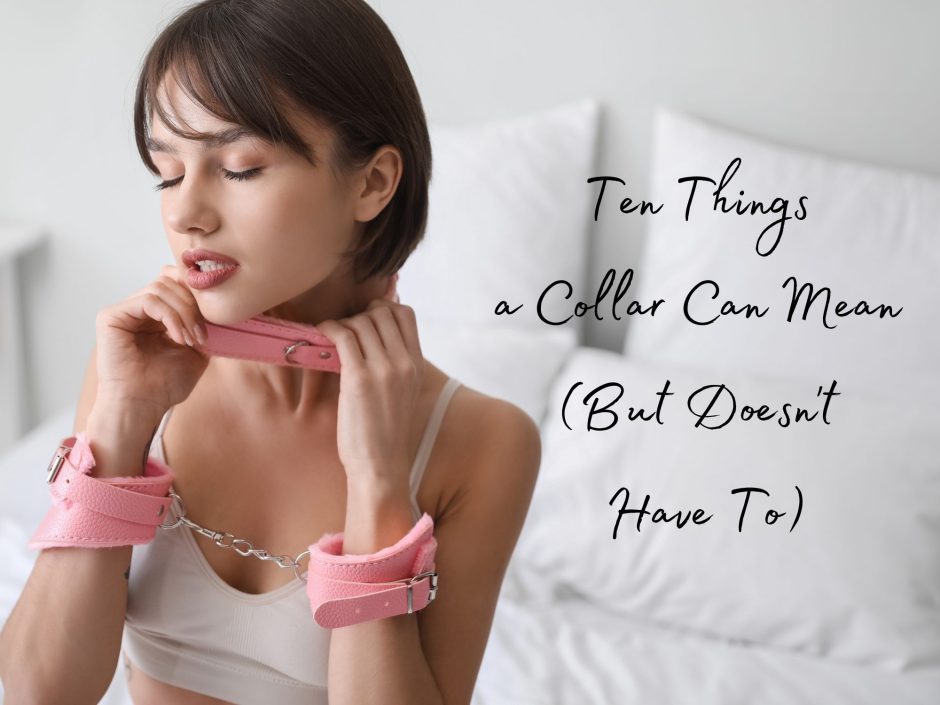
11 Things a Collar Can Mean (But Doesn’t Have To)

What is the meaning of a collar in BDSM? Ask ten BDSM enthusiasts what collaring means to them and you’ll get 20 different answers. Not all kinksters use collars in their play or D/s relationships. Amongst those who do, they can have vastly different meanings depending on context and the people involved.

A simple band around the neck can take on many different significances and be worn in many different ways. As with anything in BDSM, Here are some I thought of, though I am sure there are many more.

A Lifetime Commitment: Collaring as a BDSM Marriage

Some kinksters view their collar as akin to a wedding ring. They may or may not also be legally married to their partner, and they may or may not also wear a traditional wedding ring, but they view their collar as the outward symbol of their lifetime commitment to a BDSM relationship.

Some couples choose to formalise their collaring with a ceremony. This can be performed privately or in front of friends and loved ones.

BDSM Collar Meaning: Permanent Ownership

Some people use “owner/property” dynamics as part of their kinky relationships. In these contexts, the submissive may wear a collar as a symbol that they are the property of their partner. Some couples choose a permanent collar that cannot be removed without a key. If you go down this route, always make sure the wearer has a spare in case of an emergency.

BDSM Collar Meaning: Temporary Ownership

Not all kinksters want to be in a 24/7 or lifetime BDSM relationship, but still want to go deeply into a Dominant or submissive headspace. For these people, a collar can serve as a sign of temporary ownership, whether for the length of a scene, a day, a weekend, or longer. However, when the collar comes off or the context changes, the ownership dynamic also ends or transitions back into an equal partnership.

Self-Collaring: A BDSM Collar Meaning “I Belong to Me”

I have a collar I bought for myself. When I wear it, it’s a reminder that I am owned by no-one but myself. My body, my choices, and my heart are mine. I might choose to give them away to trusted people for short amounts of time, but they always come back to me at the end. Self-collaring can be a reminder to be true to yourself, a way to access your submissive identity when you don’t have a dominant, a reminder to take care of yourself, and so much more.

Keeping a Connection and Closeness Alive with a Collar

Perhaps you’re in a long-distance or non-nesting relationship. Maybe you just want to feel close to your partner and keep your D/s dynamic alive when you’re not physically together. Regardless of your circumstances, wearing a collar can be a great way to do this. Many couples choose a day collar for this purpose, which can symbolise your relationship without raising any eyebrows in public.

Collars of Consideration or Training

Some people who practice formal BDSM relationships follow a series of steps leading up to permanent collaring. During this process, the submissive may wear a “training collar” or “collar of consideration” for a period of time before receiving their permanent collar. As with anything in a BDSM dynamic, negotiate the meaning of each collar clearly with your partner at every step of the process.

Collars as a Way of Getting Into a Headspace

Whatever your kinky headspace looks like, putting a collar on your submissive partner or having one put on you can be a “shortcut” to accessing that headspace. For people who play at events or parties, putting on the collar at the start of the night is often part of the getting-ready ritual.

Collars Signalling “Leave Me Alone, I’m Taken”

This isn’t foolproof, but I’ve found that if I’m attending a kink event unpartnered and I don’t want to be hit on, wearing a collar will significantly cut down on the unwanted attention I receive.

Because BDSM collars can have so many different meanings and not everyone is monogamous, people won’t necessarily assume that your collar means you’re unavailable. But at least some likely will. Think of it as the kinky equivalent of flashing a wedding ring when the creepy guy at the bar isn’t getting the hint.

No Deep Meaning: A Collar as a BDSM Tool

For some people, a collar is part of a scene that’s there for what it can do rather than what it means. This might mean attaching a leash to lead your submissive around a party, cuffing their hands to their collar to immobilise them, or using it to tug them in for a kiss.

Collars as Decorations or Fashion Accessories

Collars look pretty and can add a kinky twist to an outfit quickly and easily. I have one I love that was sent to me for review. It has no meaning attached to it and isn’t connected to any particular relationship. I wear it because I like how it looks.

Flagging Kinky in Public

The idea of flagging originates from the “hanky code”, which was pioneered by gay and bisexual men in the 1970s. Coloured handkerchiefs placed in certain positions are used to indicate interest in various sexual roles and practices. Flagging has come to refer more broadly to using outward symbols to subtly indicate your proclivities to other interested parties.

There are many spaces where, though they’re not kink-specific events, a lot of the participants will likely be kinky. Think adults’ LGBTQ+ community events, goth clubs, geek and sci-fi events, Renaissance Fairs, and so on. In these spaces, the meaning of a BDSM collar can be “hey, we have this thing in common!”. You might even make some new friends.

The Taboo Brighton Logo

This post was sponsored by Taboo Brighton. Taboo launched in 2003 and has established itself as a genre-defining Brighton retail experience. The store was awarded “Best Sex Shop in the UK” at the Erotic Trade Awards. It was also once described in The Guardian as the “Dolce and Gabbana of Sex Shops”. All views and writing are mine.

6 Benefits of Going to a Kink Munch (Apart from Finding Partners)

If you ask experienced kinksters for their advice on exploring the BDSM world for the first time, they’ll most likely advise you to find a kink munch to attend.

What is a BDSM Munch and What Happens There?

A BDSM or kink munch is a social gathering of kinksters, usually in a setting like a pub, bar, or restaurant. Munches are usually no-play spaces where people wear everyday clothing and get to know one another in a purely social setting.

Some munches have activities, such as icebreakers or getting-to-know-you games. Others are totally informal, just like going to the pub with a group of friends. Some are for particular demographics – such as submissives, under 35s, women and other marginalised genders, or queer folks – while others are open to everyone.

Almost all major cities have at least one munch, and many have several. I live in a medium-sized city and there are at least ten munches a month that I know of.

6 Benefits of Going to a Kink Munch

When they’re new to BDSM, many inexperienced kinksters want to jump straight into their first kink party or find a Dom or sub and get on with playing. I understand the desire but I think this is a mistake. Here are six reasons why I think a kink munch should be your first event, which have little or nothing to do with finding people to play with.

You’ll Make Friends

I’ve got dear friends I first met at munches who I hope will be in my life forever. Kinksters are a friendly crowd and we love helping newcomers find their feet. You’ll meet all kinds of people at a BDSM munch, and not everyone will be your new bestie, but keep an open mind and chat to as many people as you can.

The trick to making friends at a kink munch is to treat it like you would any other situation with new people. If in doubt, ask people about themselves, though avoid overly personal questions. Many kinky people are circumspect about sharing “real world” details about their lives.

Avoid intrusive sexual questions or starting out by asking someone what they’re into. If in doubt, “how long have you been in the community?” or “what do you like to do for fun outside of kink?” are generally safe starting points.

You’ll Build a Reputation

Kinky people like to protect our own, and many of us strive towards robust community safeguarding. That’s why kinky social standings can be made or broken on reputation. Fortunately, it’s pretty easy to start building a good reputation as long as you’re a basically decent person. Becoming a regular at your local kink community’s munch is a great way to do that.

Be friendly, kind, honest, respectful, and honour consent at all times (including small interactions like asking before hugging someone.) When you start playing, negotiate thoroughly and practice risk-aware consensual kink.

In other words, be the kind of person you’d want to be friends with and maybe play with.

You Might Get Invited to Better Parties and Events

Some kink parties are broadly open to anyone who buys a ticket. These can be great, but many other events are private, semi-private, vetted, or invite-only.

The key to getting invited to those events? Make friends, build a good reputation, and be the kind of person others want to be around. Open, social kink events like munches are the best way to do this. This won’t happen overnight, but be yourself and get to know other people as friends and you might soon have a shiny new kinky social life.

It’s a Safer Way to Vet People

If you’ve met someone you might like to play with, learning how to vet a Dom or a sub is a vital tool in staying safe. If you’ve been chatting online, meeting at a kink munch is a safe and low-pressure way to get to know someone. Or if you’ve met someone in the local community and are curious if they’re really as great as they seem, your new kinky friends will be well placed to let you know if your prospective Mr/Ms/Mx Right is a good person to get involved with.

You’ll Build Knowledge

Something to know about kinksters? We’re fucking nerds in the best possible way. Want to learn more about some cool kinky skill or implement you’ve come across, or just about BDSM and the community in general? Your local community is your best resource.

Generally speaking, we kinksters love to enthuse about our “thing” and share our knowledge with anyone who wants to listen. So open your mind, listen up, and get ready to learn all kinds of amazing things. And if you want to ask a particular person at the munch about a kink or activity you know they’re experienced in? Go for it.

A Kink Munch is a Safe Place to Be Yourself

As kinksters, we know that our sexuality lives on the fringes. We may not be able to be safely “out” about our proclivities to people in our lives. In addition, a large percentage of us are queer, trans, neurodivergent, disabled, or have other marginalised identities. This means that you are likely to find a community full of welcoming, accepting people.

In the right kink space, you don’t need to hide your sexuality, your gender, your social awkwardness, or your nerdy hobbies. You’re welcome exactly as you are.

Do you find my work useful? Sharing it on Bluesky or Fetlife or buying me a coffee is a great way to say thanks <3